REVIEW · NAPLES
Pompeii and Vesuvius Full Day Private Shore Excursion
Book on Viator →Operated by Askos Tours · Bookable on Viator
Pompeii and Vesuvius in one tight plan. I like the skip-the-line style entry into Pompeii and the chance to walk the ruins with an archaeologist guide, not just a generic audio tour. The one real catch is the steep, slippery Vesuvius walk (about the last 500 meters, plus a short uphill climb), so wear proper shoes and keep your expectations realistic.
This is built for a true private day. You ride in a modern minivan with a professional driver, and you get pickup and drop-off from the Naples area down through Sorrento and toward Salerno and the Amalfi Coast, which saves you the stress of figuring out trains and buses on your own.
The tour is also smart about time. You get a guided Pompeii block long enough to make the city feel logical, then you shift gears to the crater area at Vesuvius for the best views of the Bay of Naples—then head back to where you started.
In This Review
- Key highlights at a glance
- What you’re really paying for on a private Pompeii and Vesuvius day
- Starting in Naples (and beyond): pickup that keeps the day sane
- Beating the Pompeii crush: Porta Marina and skip-the-line entry
- Pompeii stops you’ll actually want to remember
- Basilica: the portico where commerce happened
- Casa del Menandro: wealthy house with standout decor
- Main street walk: the city’s spine
- Forum and Granai del Foro: center of power and storage
- Lupanar: the famous brothel lane
- Casa del Fauno: big, impressive, and private
- Stabian Baths: Pompeii’s older thermal complex
- Teatro Piccolo and Teatro Grande: different crowd sizes
- The Vesuvius half: crater views, the 500-meter climb, and what to bring
- Lunch on your terms: slopes, choices, and how to not lose the day
- Transport and timing: a 7-hour day that fits real travel days
- Price and value: is $568.94 per person worth it?
- Who this Pompeii and Vesuvius tour is best for
- Should you book this private Pompeii and Vesuvius day?
- FAQ
- How long is the Pompeii and Vesuvius private shore excursion?
- Is this tour private or shared?
- Where does pickup happen?
- What language is the tour offered in?
- Is Pompeii admission included?
- Is Vesuvius admission included?
- Is lunch included?
- How much walking is involved?
- Is the tour suitable for reduced mobility?
- What’s the cancellation policy?
Key highlights at a glance
- Skip-the-line Pompeii access with admission fees handled for you
- Licensed Pompeii guide (many groups get an archaeologist-level guide)
- Vesuvius crater viewpoints with the “still smoking slightly” scene
- Private minivan pickup and drop-off from Naples, Sorrento, Salerno and nearby
- A packed Pompeii route that hits the street life, public squares, and theaters
What you’re really paying for on a private Pompeii and Vesuvius day
At $568.94 per person, this is not the cheap option. But private days like this are where the money goes: you’re buying transport, timing, and on-the-ground interpretation.
For Pompeii, the value isn’t just seeing ruins. It’s having someone help you connect the dots fast: where people walked, how business worked, where crowds gathered, and what everyday objects and buildings meant in a city that was frozen in time. In the reviews tied to this tour style, the Pompeii guide is often the main reason the day lands well, with guides like Mareluce, Mena, Enzo, and Barbara showing up as standout names.
Then Vesuvius is the other half of the bargain. You get driven up, brief guidance, and a planned time window to reach the crater area and look out over the bay.
If you're still narrowing it down, here are other tours in Naples we've reviewed.

Starting in Naples (and beyond): pickup that keeps the day sane
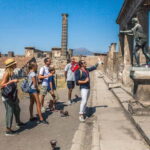
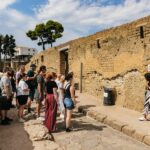
The tour is set up with pickup from your accommodation or a nearby meeting point in the Naples area, and also in the Sorrento, Salerno, and Amalfi Coast zones. That matters because Pompeii is a real timing game: add transfers, parking, and lineups, and the day can shrink fast.
You travel in a modern minivan with a professional driver. In review stories tied to this experience, drivers such as Luigi, Luca, and Lucca were praised for keeping the trip smooth and for making the whole day feel easy. Even if you don’t remember the driver’s jokes, you’ll feel the benefit: you spend less mental energy on logistics and more on the sights.
You should also be ready to share pickup details in advance, including your accommodation address and a visible nearby shop name (and train or flight info when relevant). That’s how the pickup stays on track.
Beating the Pompeii crush: Porta Marina and skip-the-line entry
Pompeii is famous for a reason, and that reason comes with crowds. This tour is designed to reduce the usual headache by including Pompeii admission and skip-the-line style entry.
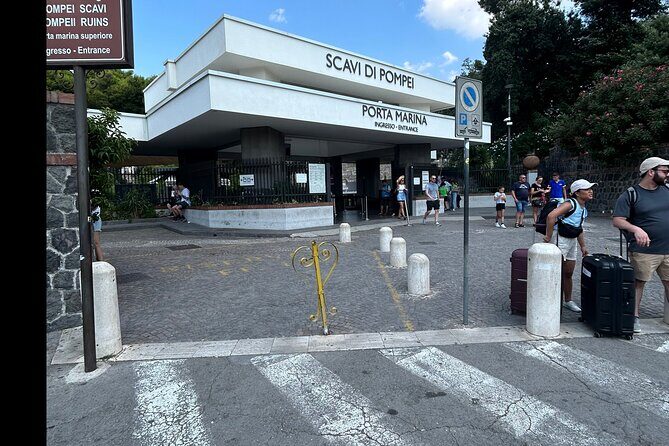
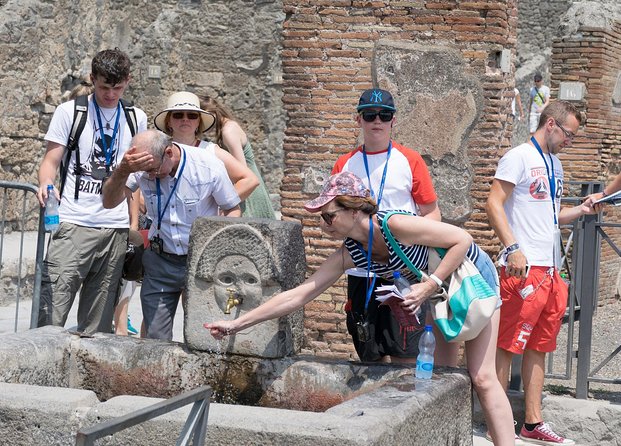
You enter through the main entrance called Porta Marina, then step into the ruins with a guided flow. The guided portion in Pompeii is listed as about 2 hours, with additional short stops around major highlights. The pacing is fairly efficient: each key stop tends to be in the 10 to 15 minute range, which keeps you moving without turning the day into a blur.
If you’re worried about getting lost or not understanding what you’re looking at, this is where the tour helps most. Pompeii is not one building; it’s a whole city. A guide acts like a translator for the street layout, the public spaces, and the architecture that looks random until someone explains how it worked.
Pompeii stops you’ll actually want to remember
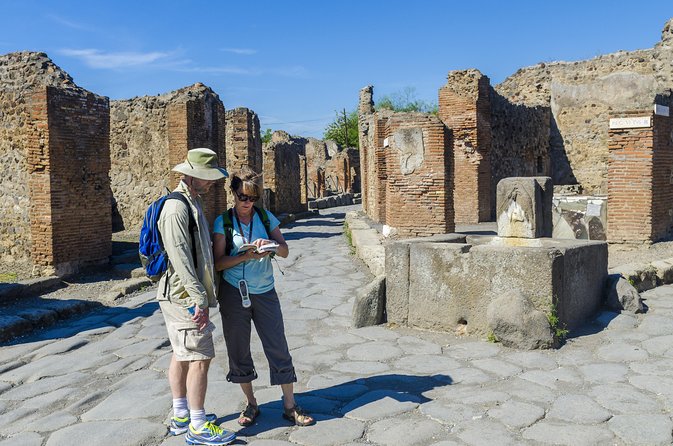
The route covers a spread of Pompeii that balances public life, private homes, and signature “wow” areas. Here’s what each part does for you, and what to watch for.
Basilica: the portico where commerce happened
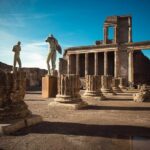
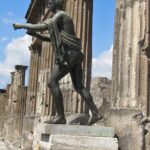
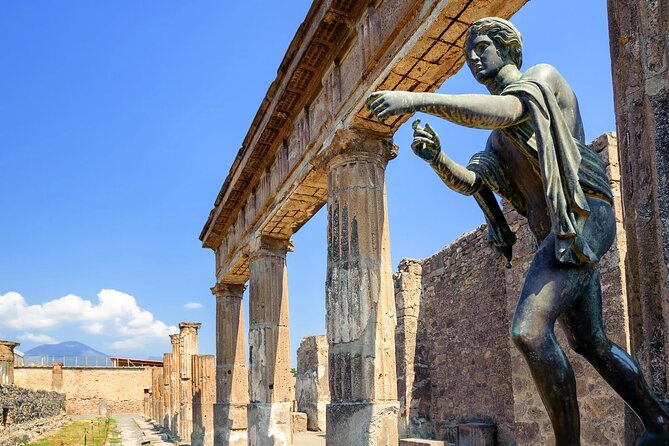
The Basilica here is described as an open portico sheltering merchants and other activities. Think of it as a covered meeting zone—less about grand worship and more about daily deals and movement. This kind of space is important because it teaches you how Pompeii’s public areas functioned.



Casa del Menandro: wealthy house with standout decor
Casa del Menandro is one of the richer private residences, with emphasis on architecture, decoration, and contents. Houses like this help you understand that Pompeii wasn’t only streets and damage; it was also status, artistry, and household routines.
Tip: When you’re in a house, focus on layout and scale. The biggest takeaway is often how the home is organized, not just which room looks impressive.
Main street walk: the city’s spine
You’ll walk through the main street of Pompeii. This is where everything starts to feel like a real place rather than a collection of monuments. The street line gives you a sense of scale and direction, and it helps you connect the public zones you saw with where people moved day to day.
Forum and Granai del Foro: center of power and storage
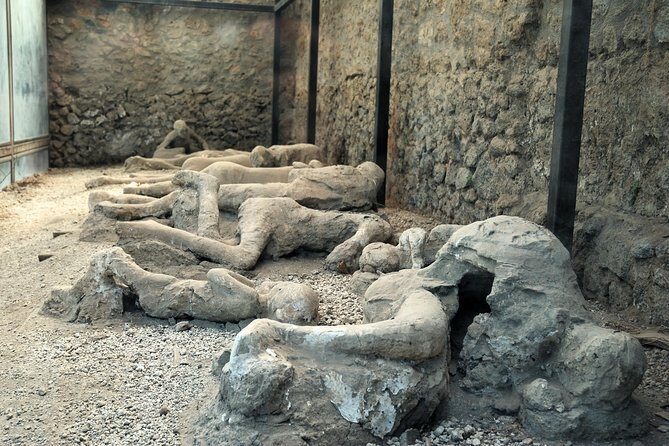
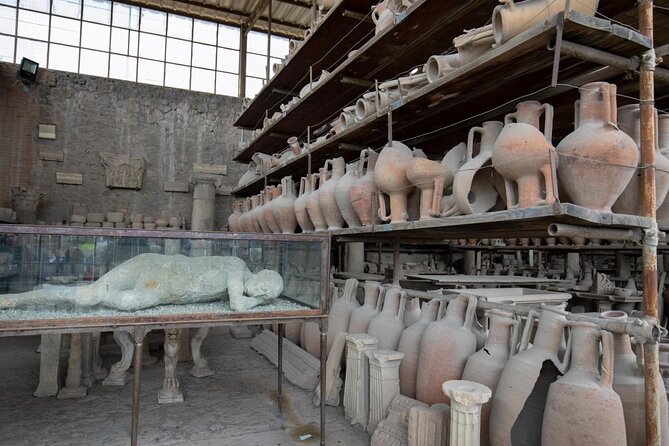
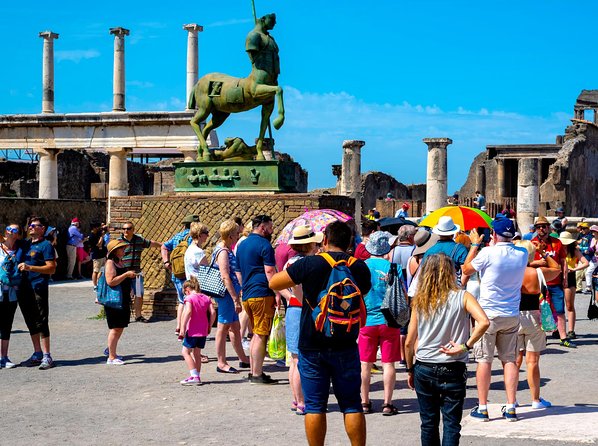
You get time at Foro de Pompeya, the ancient main square. Then you move to the Granai del Foro, described as a granary with marble tables and features connected to fountain systems at entrances of houses, plus casts connected to the eruption’s victims (and also a dog and a tree cast).
This pairing is valuable because it shows two sides of the same area: political and social space (the Forum) plus the practical infrastructure (storage and public water features). Pompeii’s tragedies are part of the story, but so is how the city ran.
Lupanar: the famous brothel lane
The Lupanar stop is short, but it’s one of Pompeii’s most talked-about sites. It’s often the building people remember most clearly, partly because it’s so specific. Here, the guide’s job is to explain context without turning it into sensationalism.
Casa del Fauno: big, impressive, and private
Casa del Fauno is one of the largest private residences in Pompeii. The value of this stop is contrast. You see how wealth lived side-by-side with street life, and how private space worked in a city that was still very much communal.
Stabian Baths: Pompeii’s older thermal complex
The Stabian Baths (Terme Stabiane) cover a vast area and are noted as the oldest thermal complex in the city. Baths were social hubs, not just places to wash. Seeing these ruins makes it easier to picture how people spent time, met neighbors, and handled daily routines.
A useful mindset: treat the baths like a public works project plus a hangout—water access, movement through rooms, and the social rhythm.
Teatro Piccolo and Teatro Grande: different crowd sizes
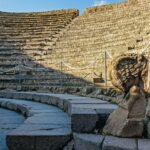
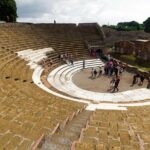
You get views of the Teatro Piccolo and then visit Teatro Grande, described as Pompeii’s most important theater. It’s a good way to end the Pompeii segment: the theaters help you understand public entertainment and gatherings.
Even with short stop times, theaters leave strong impressions. Look at entrances and seating arrangements so you can imagine how crowds flowed.
The Vesuvius half: crater views, the 500-meter climb, and what to bring
After Pompeii, you transfer to Mount Vesuvius for the climb and crater area. The tour includes the admission fee listing for Vesuvius in the details you receive, and it also notes that the Vesuvius entry ticket is 11 euros. Because the written materials also say admission tickets are not included in one place, I strongly suggest confirming what your booking confirmation states for your specific voucher.
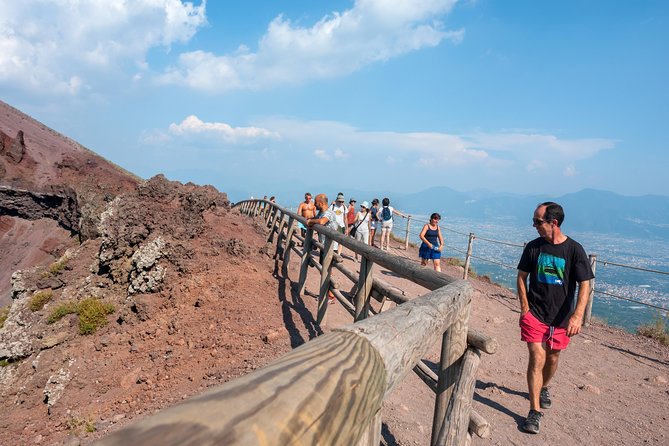
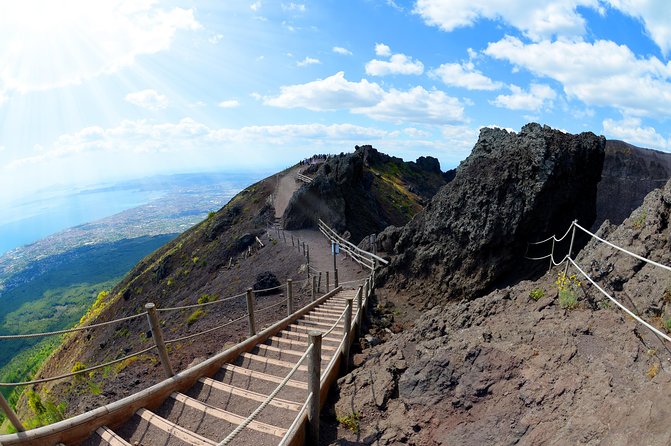
Here’s what matters most on the ground: the crater viewpoint includes a steep uphill walk, with the last 500 meters called out as steep. Closed-in shoes are essential. One review account also described loose gravel and the need for good shoes and water.
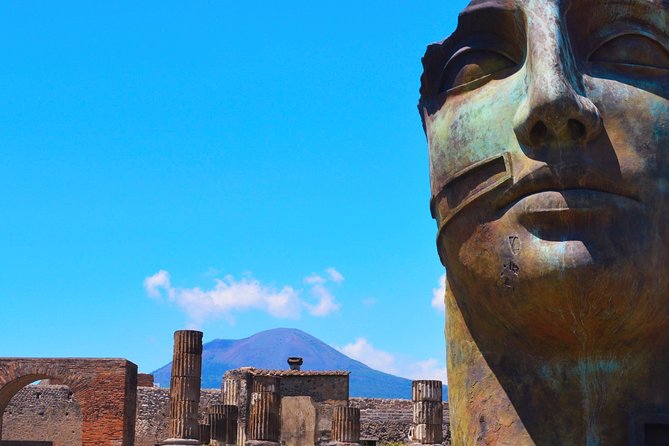
Your Vesuvius time is listed as about 2 hours, and the crater moment is the star: you’re going up to see the crater where it still smokes slightly. Then you get wide views over the Bay of Naples, Capri, Ischia, and the edge of the Sorrento coast.
Practical tips that will save you:
- Bring water if you can, because you’re working uphill on uneven ground.
- Wear shoes with grip. If the path feels slippery in the moment, you’ll be glad you planned.
- Pack light. The walk is short but not easy.
One fun detail from a review experience: a family celebrated the climb with lemoncello at the top. It’s not required, but it tells you there’s a real visitor rhythm up there once you reach the viewpoint.
Lunch on your terms: slopes, choices, and how to not lose the day
Lunch is not included. You get an optional restaurant break on the slopes of Vesuvius or around Pompeii. In review stories, a driver recommended a specific spot called I Matti Pizzeria. That’s a good sign because it means your driver may point you to something workable without you hunting for a place under time pressure.
How to handle lunch well:
- Eat early enough that you’re not rushing back uphill.
- Don’t plan a long sit-down if your group energy is low.
- If you’re sensitive to heat, choose a shaded table and give yourself a few minutes to recover before continuing.
Transport and timing: a 7-hour day that fits real travel days
The duration is listed as about 7 hours. That’s a realistic full-day window for the Naples area, especially when you include pickup, driving, Pompeii time, Vesuvius time, and the return.
You should still expect the day to feel full. Pompeii is several stops on foot, and Vesuvius is the more physical segment. The tour notes a moderate fitness level and says it’s not suitable for people with reduced mobility because the Mount Vesuvius path is steep and slippery.
If you’re traveling with kids, this can still work. One review story highlighted a guide who kept children engaged by making Pompeii information age-friendly. If your group includes younger travelers, it’s smart to ask your guide to focus on street life and practical details, not just dates and names.
Price and value: is $568.94 per person worth it?
This price is mostly paying for the private part: door-to-door pickup and drop-off, a dedicated minivan, admission handling for Pompeii (and Vesuvius as noted), plus a guided Pompeii block.
When it makes sense:
- You’re a family or small group where private transport beats negotiating buses and schedules.
- You want a real guide who can point at the right places and make the ruins understandable quickly.
- You care about avoiding line stress and building in a smooth day flow.
When you might think twice:
- If you’re traveling solo and you’re comfortable with a self-guided approach, a shared tour could be cheaper.
- If you know the Vesuvius walk is going to be a problem for you, the value collapses because the crater part is the payoff.
A simple way to judge value is this: can your day afford the energy and time you’d spend dealing with lines, transport, and interpretation on your own? If not, the price becomes easier to justify.
Who this Pompeii and Vesuvius tour is best for
I think this fits best if you want a well-run day with minimal friction and clear guidance.
Best match:
- First-timers to Naples who want the two big-name stops without planning headaches.
- People who want Pompeii explained by a licensed guide and possibly an archaeologist-level expert.
- Families who would rather have someone manage the visit pace.
Not ideal if:
- You need step-free access or you’re relying on reduced mobility support.
- You dislike steep uphill walking, slippery paths, or uneven ground.
Should you book this private Pompeii and Vesuvius day?
Book it if you want a straightforward, private way to see Pompeii and still make it to the crater without a chaotic day. The combo of skip-the-line style entry, a guided Pompeii route with standouts like Mareluce, Mena, Enzo, and Barbara, and the Vesuvius crater payoff makes this a strong choice when your time is limited.
Skip it (or look harder) if you’re not confident about the steep Vesuvius climb or if your budget can’t stretch to a private day. Also, take a moment to verify whether the Vesuvius ticket is fully included on your specific confirmation, since the written details conflict in one place.
If you’re comfortable with moderate walking and you like the idea of someone doing the explaining so you can focus on seeing, this is the kind of day that turns a bucket-list stop into something you can actually picture later.
FAQ
How long is the Pompeii and Vesuvius private shore excursion?
It’s listed at about 7 hours.
Is this tour private or shared?
It’s private. Only your group participates.
Where does pickup happen?
Pickup is offered from Naples, Sorrento, and the Salerno area and their surroundings, including accommodations and nearby meeting points.
What language is the tour offered in?
The tour is offered in English.
Is Pompeii admission included?
Yes, Pompeii admission is included, and skip-the-line admission fees are part of the tour setup.
Is Vesuvius admission included?
The details you receive list Mount Vesuvius entry as 11 euros, and they also list Vesuvius admission fees as included. Because the documentation mentions admission tickets in another place, confirm the exact wording on your booking confirmation.
Is lunch included?
No. Lunch is optional and is on your own expense.
How much walking is involved?
You’ll do a moderate amount of walking in Pompeii, and the Vesuvius portion includes a steep uphill walk (including the last 500 meters). Closed-in shoes are recommended.
Is the tour suitable for reduced mobility?
No. The tour is not suitable for people with reduced mobility due to the steep and slippery Mount Vesuvius path.
What’s the cancellation policy?
Free cancellation is available up to 24 hours in advance for a full refund. Canceling less than 24 hours before start time isn’t refundable.