REVIEW · NAPLES
Private Herculaneum Tour – Top Experience with Local Guide
Book on Viator →Operated by Leisure Italy · Bookable on Viator
Herculaneum feels startlingly alive. This private outing lets you walk ancient Roman streets with on-the-spot guidance and see how people worked, relaxed, and traded in a town far better preserved than Pompeii. Two things I really like: the human scale of the site (smaller, calmer, easier to take in) and the way a guide helps you read what you’re seeing, from waterfront life to elegant houses.
The optional add-on is also a smart move. If you’re the kind of person who likes ending a history day with something sensory, the Cantina del Vesuvio visit on the Vesuvius slopes adds a relaxed lunch and wine tasting with a local enologist. The only real consideration: you’ll do a moderate amount of walking, so comfortable shoes matter, especially if you choose pickup and/or a longer schedule.
In This Review
- Key Highlights You’ll Actually Care About
- Why Herculaneum Beats Pompeii for a Clearer Day
- Private Guide Time: How It Changes What You Notice
- Getting There From Naples or Sorrento: Pickup vs. Walk-Up
- Parco Acheologico di Ercolano: The Town That Feels Human-Scale
- The Maritime Story: Boat Pavilion, Antiquarium, and the Ancient Beach
- Waterfront Homes That Signal Status: Casa dei Cervi and Casa di Nettuno e Anfitrite
- Roman Social Life in Real Space: Palestra and Women’s Baths
- Everyday Marketing and Privacy: Ad Cucumas and Casa del Tramezzo di Legno
- Casa del Bicentenario: A Refined Townhouse With Legal Clues
- Sacello degli Augustali: Imperial Cult in a Provincial City
- The House of the Skeleton: Where the Tour Turns Quiet and Heavy
- Add the Vesuvius Winery Lunch: Cantina del Vesuvio (Optional)
- Time, Pace, and Footwear for a 2 to 6 Hour Plan
- Price and Value: Is $142.82 Reasonable?
- Who Should Book This Private Herculaneum Tour?
- Should You Book It?
- FAQ
- How long is the Private Herculaneum Tour?
- What does the tour cost?
- Is admission included?
- Do I need to speak Italian?
- Is this a private tour?
- Do you offer pickup?
- Where do we meet?
- Is there an optional lunch or winery visit?
- How much walking is involved?
- What if I need to cancel?
Key Highlights You’ll Actually Care About
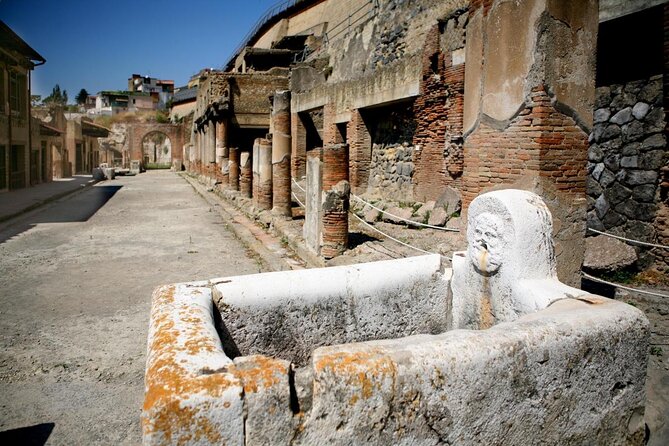
- Private group attention so you can set the pace and ask questions at the moments that matter.
- Boat Pavilion and the waterfront remains show Herculaneum’s final hours through carbonized boats and the shoreline.
- Antiquarium orientation gives you original artifacts first, so the ruins make instant sense.
- Refined houses with wooden preservation (including a rare wooden partition) that feel shockingly real.
- Optional Vesuvius winery lunch ties volcanic terroir to the wine locals have made for generations.
Why Herculaneum Beats Pompeii for a Clearer Day
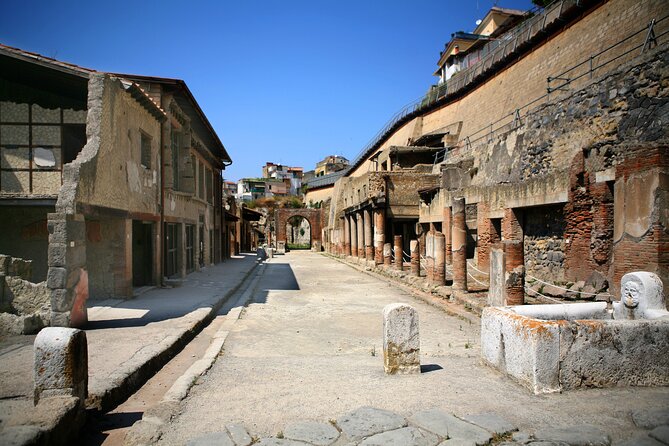
Herculaneum is close to Pompeii, but it gives you a different kind of experience. Pompeii often feels like a sprint through a loud, sprawling ruin field. Herculaneum tends to feel more manageable—smaller, quieter, and easier to wrap your head around.
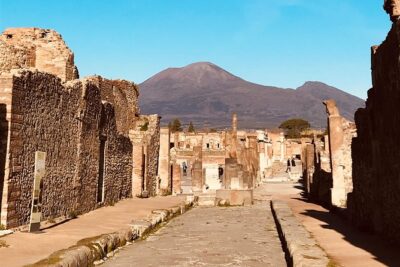
You’re not just looking at stone. You can encounter everyday stuff: colorful frescoes, mosaics, shops, bathhouses, even carbonized remains that preserve details people can’t unsee once they understand what they’re standing on. With a guide steering the story, you’ll spend less time guessing what a room or object once was, and more time seeing why it matters.
If you’ve already done Pompeii, this tour is the natural “follow the thread” move. Instead of repeating the same theme, you get a town where domestic life and the sea sit side by side.
If you're still narrowing it down, here are other tours in Naples we've reviewed.
Private Guide Time: How It Changes What You Notice
This is a private tour, meaning it’s just your group. That sounds obvious, but it’s the difference between trudging through ruins and actually understanding them. On a private schedule, you can linger when a detail grabs you—like a mosaic, a technical feature in the baths, or the way the waterfront buildings are arranged.
Local guides also help you connect the dots between structures. One reason Herculaneum can feel confusing without support is that the city is full of small clues. A good guide turns those clues into a narrative you can remember days later.
In the guide lineup, names like Fabrizio and Paulo come up often, and the common theme is simple: they focus on clear explanations and thoughtful pacing. You also get that sense of “we’re not rushing you,” which is a big deal here because the site rewards attention.
Getting There From Naples or Sorrento: Pickup vs. Walk-Up
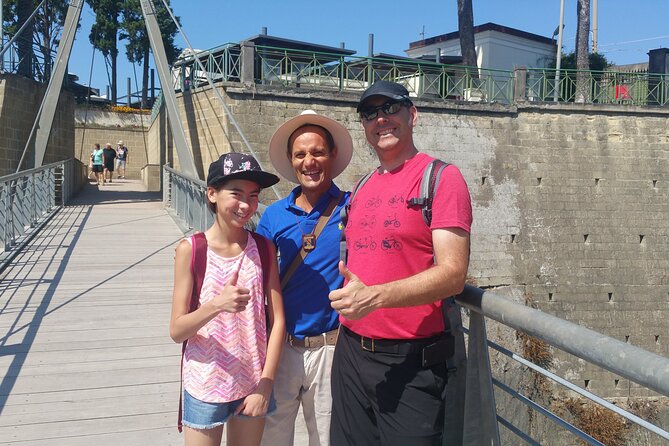
You’ve got two ways to start. If you choose the private transportation option, you can get pickup anywhere in Naples or Sorrento. That’s ideal if you don’t want to manage transit, transfers, or timing.
If you pick the walking tour option, you’ll meet the guide at the Archaeological Park of Herculaneum, Corso Resina 187, 80056 Ercolano NA, Italy. The tour ends back at the meeting point.
Either way, plan for moderate walking. The site involves uneven ground and lots of time on your feet. Bring comfortable shoes with solid grip. Also remember this is a mobile ticket experience, so you’ll want your phone charged and ready.
Parco Acheologico di Ercolano: The Town That Feels Human-Scale
Once you’re inside Parco Acheologico di Ercolano, you’ll see why people talk about Herculaneum as calmer and more readable than Pompeii. The town was smaller, and it was preserved with details that help your imagination do its job.
Your guide typically sets the tone fast: this wasn’t a generic “lost city,” it was a real place with different neighborhoods and different lifestyles. You’ll notice how materials and architecture hint at daily routines. You’ll also learn to spot what’s unusual—especially the preserved wooden elements that make the ruins feel almost frozen in time.
One underrated benefit of going with a private guide is that you can customize your focus. If you care more about trade and the sea, your route makes more sense. If you care about daily routines and domestic life, the houses and baths will click sooner.
The Maritime Story: Boat Pavilion, Antiquarium, and the Ancient Beach
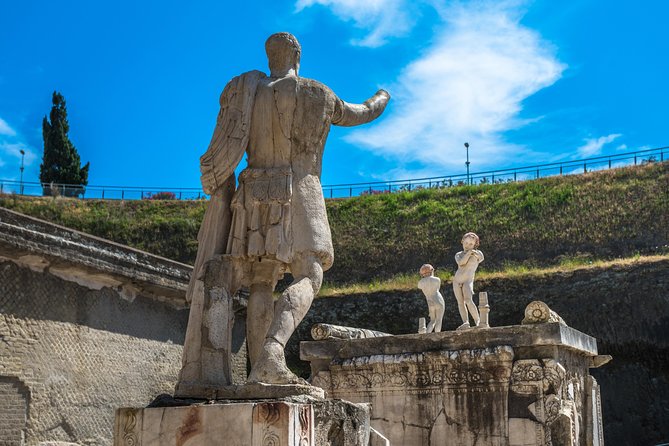
Herculaneum’s waterfront element is where the emotion lands hardest—and it starts early.
At the Boat Pavilion, you’ll see carbonized remains of ancient boats and waterfront structures. These are not just “cool artifacts.” They help archaeologists reconstruct how the town worked with the sea—fishermen, merchants, and officials using the shoreline for trade and transport. The preservation under volcanic debris is what makes this stop so powerful. It mixes science with storytelling, and your guide helps you connect the boats to the final chaotic moment.
Next is the Antiquarium. This small museum is like a fast orientation manual. Instead of starting with ruins and hoping you’ll understand, you begin with original artifacts—statues, inscriptions, household objects, and personal items. One standout detail is the charred timbers preserved by volcanic heat, which gives you rare evidence of wooden architecture. When you then step outside into the site, you’ll have a mental map of what you’re looking at.
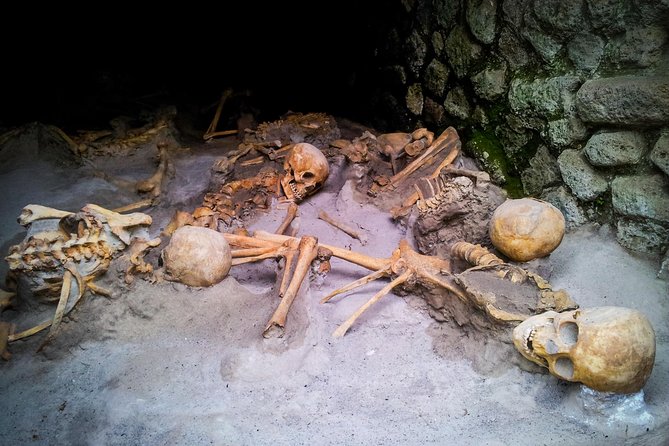
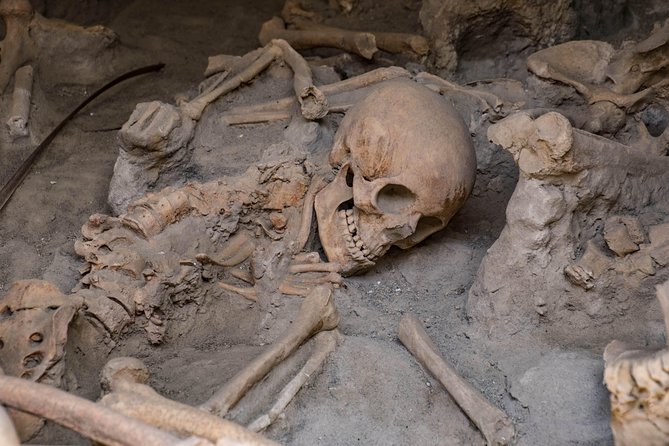
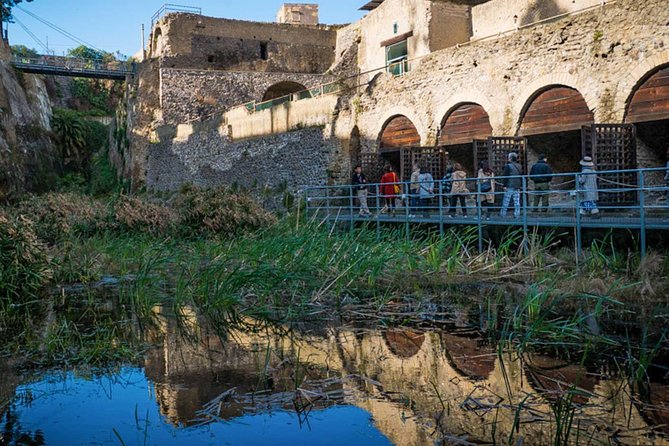
Then comes the ancient beach. This is one of the most moving areas: vaulted boat houses along what used to be the shoreline, where archaeologists uncovered skeletons of hundreds of people. Seeing remains in situ makes the tragedy feel personal in a way that photographs don’t match. It also explains the town’s proximity to the sea—and how the pyroclastic surge overtook the waterfront quickly, preserving that moment for nearly two millennia.


Waterfront Homes That Signal Status: Casa dei Cervi and Casa di Nettuno e Anfitrite
After the waterfront stops, the tour naturally shifts from survival and trade to lifestyle.
At Casa dei Cervi, you’ll find one of Herculaneum’s elegant waterfront homes. Your guide helps you read the architecture and lifestyle clues: marble floors, colonnaded garden, and rooms once decorated with fine frescoes. It’s easy to picture a wealthy family enjoying sea breezes and a private terrace. The house’s modern name comes from marble stags being attacked by hunting dogs—statues discovered in the garden and displayed separately. It’s a detail that turns a ruin into an actual home with taste and symbolism.
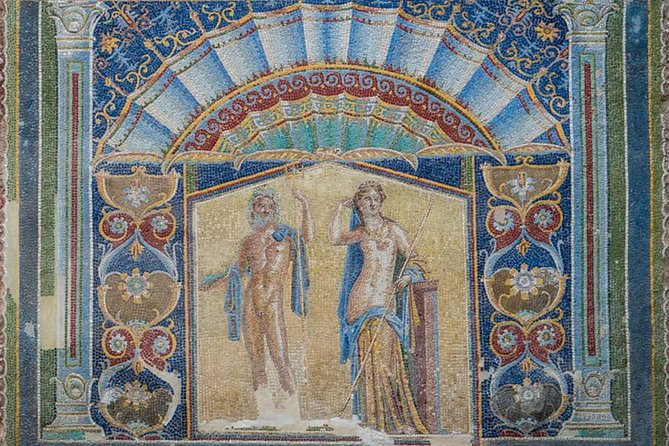
Then you’ll visit Casa di Nettuno e Anfitrite, where art does the talking first. The wall mosaic with Neptune and the nymph Amphitrite uses tiny glass tesserae that still shimmer with blues and golds. Around it, you’ll also see traces of a private dining area and a richly decorated nymphaeum, which hints at dinners meant to impress guests. Your guide points out practical details too—water channels and garden traces—so the house feels like both beauty and function.
Roman Social Life in Real Space: Palestra and Women’s Baths
Not every stop is about wealth or disaster. Some are about routine.
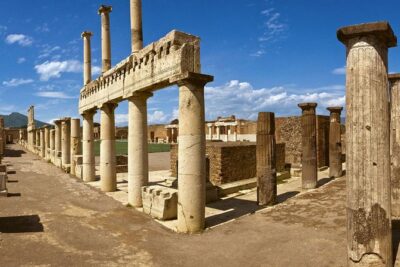
The Palestra functioned as a sports and social club. You’ll walk into a big open courtyard framed by porticoes. It helps you imagine young men training, practicing wrestling, running drills, or relaxing in the shade after workouts. The scale matters here. It suggests the palestra was part exercise space, part civic identity.
Then comes the Women’s Baths, where the engineering gets your attention fast. You’ll move through changing rooms and then into heated areas, seeing how Roman design worked: hollow floors and wall pipes once carried hot air to warm the spaces. Marble benches and mosaic floors add elegance. Even the decoration—geometric patterns and marine themes—suggests the baths were as much about conversation and relaxation as cleanliness. Your guide helps make the space feel less like “bathroom ruins” and more like a daily meeting place.
Everyday Marketing and Privacy: Ad Cucumas and Casa del Tramezzo di Legno
If you want a stop that feels weirdly familiar, go to Ad Cucumas. It’s an ancient advertisement painted right onto a tavern wall, promoting wine by the jug. The text is still legible enough to show different prices for different quantities. This is the moment when ancient commerce becomes personal. You’re watching a street-level sales pitch, long before modern signage and paper menus.
Then shift to domestic privacy with Casa del Tramezzo di Legno. This house is famous for a wooden partition wall. The folding screen was carbonized and preserved in a way that’s rare at Roman sites. Walking through the rooms, you can still read social choreography: where guests were welcomed, where business may have happened, and where family life retreated from view. It’s the kind of detail that makes ancient social norms feel immediate, not abstract.
Casa del Bicentenario: A Refined Townhouse With Legal Clues
The Casa del Bicentenario is a strong choice for people who like houses that show how real families lived, not just how rich they were.
You’ll see vivid wall paintings, wooden partitions, and marble thresholds—details that suggest a home designed for both daily life and social display. There’s also a small shrine with delicate frescoes, hinting at domestic religion. Archival photographs on site connect the modern excavation story to an earlier discovery period, which makes the ruins feel like a long work-in-progress.
One extra detail that makes this stop stand out: excavations here yielded carbonized wooden writing tablets tied to property and inheritance disputes. That means you’re not only looking at rooms where people ate and hosted. You’re seeing traces of legal affairs, too, and the active civic role behind the scenes.
Sacello degli Augustali: Imperial Cult in a Provincial City
Not everything in Herculaneum is “local.” The Sacello degli Augustali adds a political and religious layer that’s easy to miss on your own.
This small temple-like building was dedicated to the imperial cult, where local elites honored the emperor as a living symbol of Rome’s power. Inside, you can still pick out fragments of frescoes featuring Hercules alongside members of the imperial family. It’s a clever pairing that links mythology with imperial propaganda. The result is a site that feels less like a sealed-off village and more like a community tied into the wider Roman machine.
The House of the Skeleton: Where the Tour Turns Quiet and Heavy
The Casa dello Scheletro, or House of the Skeleton, is one of those places that stays in your head after the tour ends.
The stark reality is unavoidable: skeletal remains of a resident were discovered here. Around the bones, you can still see architectural details like room divisions, decorative flooring, and fresco fragments. This stop doesn’t ask you to admire. It asks you to remember that Herculaneum was a lived-in town, not just a preservation project.
Your guide typically helps you hold both ideas at once: the archaeological importance of the evidence, and the human weight of the interruption. It’s a quiet moment, but it’s also one of the most honest parts of the day.
Add the Vesuvius Winery Lunch: Cantina del Vesuvio (Optional)
If you have the time, the optional Cantina del Vesuvio stop can be a great capstone. It’s a family-run winery on the Vesuvius slopes with volcanic soils that shape grape cultivation over generations.
Here’s what you’re looking at, in practical terms: an enologist walks you through the vineyards and explains how terroir affects native varietals used to produce Lacryma Christi. Then you get a relaxed tasting and lunch. The lunch includes local dishes paired with the estate’s bottles.
And yes, the views help. From the terrace you can see across the Bay of Naples and up toward the Vesuvius summit. This pairs well with the morning’s volcanic story at Herculaneum because it turns geology into something you can taste.
Time, Pace, and Footwear for a 2 to 6 Hour Plan
The tour can run 2 to 6 hours, which matters because you should match the schedule to your energy and your travel day.
- Choose the shorter version if you want the core ruins focus.
- Add time for pickup if you’re coming from Naples or Sorrento.
- Add the winery stop if you want a full, slower day that doesn’t end in ruins fatigue.
The key is your comfort level. The route involves a moderate amount of walking. Plan on steady movement between stops and some time standing to look closely. Bring comfy shoes and keep water handy, especially in warmer months.
Price and Value: Is $142.82 Reasonable?
At $142.82 per person, this private tour isn’t cheap, but it also isn’t just “ruins with a ticket.” The value comes from a few concrete things:
- A private guide gives you interpretation, not just access.
- Admission tickets are included for the main Herculaneum visit.
- Optional private transportation can save you time and hassle if you’re staying outside the immediate area.
- The winery add-on (when selected) gives you guided vineyard time, a tasting, and lunch.
If you’ve ever done a self-guided ruin day, you know how fast “I’m impressed” turns into “Wait, what am I looking at?” This tour costs money so you don’t waste your limited time doing guesswork.
Who Should Book This Private Herculaneum Tour?
This is a good fit if you:
- Want a calmer alternative to Pompeii
- Enjoy history but don’t want a rushed, packed day
- Like learning through details—mosaics, bath engineering, wooden preservation, and waterfront structures
- Have already seen Pompeii and want the more intimate side of Roman life
- Prefer a private format where your group stays together and you control the pace
It also helps families. People under 18 can enter for free with valid ID. Service animals are allowed, and the tour lists moderate fitness as the expectation—so it’s not a sprint, but it’s not a sit-down tour either.
Should You Book It?
I think you should book this if you want Herculaneum to feel like a story you understand, not a pile of fragments. The combination of a private guide, the site’s preservation, and the emotionally strong waterfront stops makes it easier to remember than the average guided walk.
Skip it or shorten your plan if you hate walking on uneven ground or you know you only want a quick hit at the park. If you’re choosing between options, I’d also consider adding the winery stop if your day has room for it. It’s not required—but it turns the morning’s volcanic theme into an evening you can taste.
FAQ
How long is the Private Herculaneum Tour?
The tour is listed as approximately 2 to 6 hours, depending on the selected options.
What does the tour cost?
The price is $142.82 per person.
Is admission included?
Yes. Admission tickets are included for the Herculaneum visit and the optional winery time shown in the itinerary.
Do I need to speak Italian?
The tour is offered in English.
Is this a private tour?
Yes. It’s a private tour/activity, and only your group will participate.
Do you offer pickup?
Pickup is offered with a private transportation option. If you select that option, you can be picked up anywhere in Naples or Sorrento. If you choose the walking tour option, you meet the guide at the Herculaneum archaeological site.
Where do we meet?
The meeting point is the Archaeological Park of Herculaneum (Corso Resina, 187, 80056 Ercolano NA, Italy). The activity ends back at the meeting point.
Is there an optional lunch or winery visit?
Yes. You can add Cantina del Vesuvio Winery Russo Family since 1930, which includes vineyard time with an enologist, tasting, and a relaxed lunch.
How much walking is involved?
The tour involves a moderate amount of walking, so wear comfortable shoes and plan for time on your feet.
What if I need to cancel?
Free cancellation is available up to 24 hours in advance for a full refund. If you cancel less than 24 hours before the start time, the amount you paid is not refunded.