REVIEW · POMPEII
Pompeii Tour & Admission included in a Small Group
Book on Viator →Operated by Grand Tour Experience · Bookable on Viator
Pompeii rewards anyone who goes prepared. This small-group tour maps the big stories of 79 AD right onto the streets you’re walking, with an archaeologist-style guide who turns stone into daily life. I especially liked the included admission (so you join at Porta Marina without ticket stress) and the pace: short stops that still make room to understand what you’re seeing and where to look next.
One thing to plan for: Pompeii’s ground is uneven. You’ll deal with curb cuts and stepping stones, so comfy walking shoes are not optional—they’re the whole deal.
In This Review
- Key things you’ll notice on this Pompeii tour
- Pompeii in 2 hours: what you’ll actually cover
- Meeting at the Villa of the Mysteries and getting oriented fast
- Porta Marina to the Roman Forum: the core story of Pompeii
- Stop speed vs. learning depth
- Venus, Apollo, and Jupiter: three temple stops that explain the city’s mind
- The Forum’s buildings and baths: where business met daily routine
- Macellum and plaster casts: seeing commerce and the tragedy in the evidence
- Houses, shops, and Via dell’Abbondanza: how wealth and everyday life shared the same streets
- A note on domus and seasonal access
- Theatres and gladiator-era spaces: entertainment and power in stone
- Pacing, uneven ground, and how to make this tour comfortable
- Price and value: is $66 a fair deal?
- Guide quality is the real upgrade
- Who should book this Pompeii small-group tour
- Should you book? My straight answer
- FAQ
- How long is the Pompeii Tour & Admission in a Small Group?
- Is Pompeii admission included in the price?
- What’s the maximum group size?
- What language is the tour offered in?
- Do I get a headset for the tour?
- Where does the tour start?
- Where does the tour end?
- Does the tour include a paper map?
- Do I need to bring bottled water?
- Which stops are included besides the main Pompeii park entrance?
Key things you’ll notice on this Pompeii tour
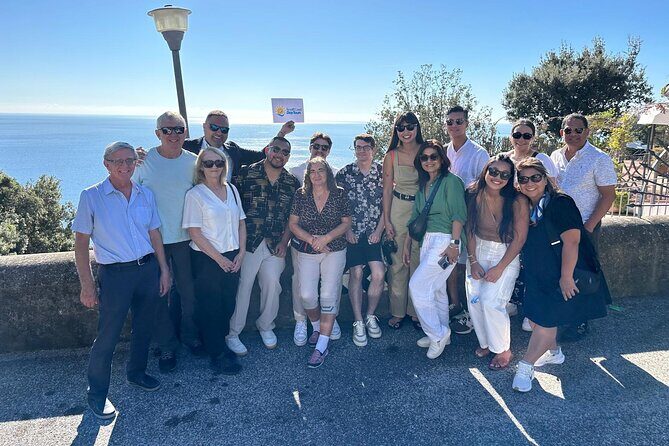
- Small group size (max 15) keeps the tour from feeling like a cattle chute.
- Admission ticket + mobile ticket means you can focus on the ruins, not paperwork.
- A headset when the site is crowded helps you catch every explanation.
- Recent highlights and reopened spaces get attention, including Roman Baths and a domus.
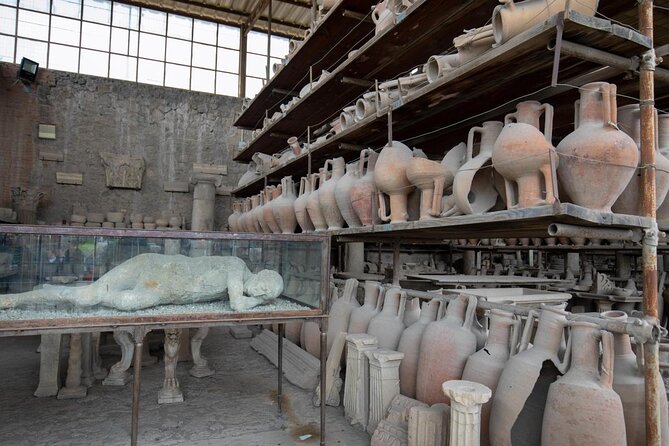
- Life-sized clues, from thermopolium (old diner) to the Macellum plaster casts.
Pompeii in 2 hours: what you’ll actually cover
This is a highlights-first Pompeii tour. That’s not a flaw. Pompeii is enormous, and trying to do everything on a first visit usually turns into speed-walking with no memory of what you saw.
The format is smart: you move through major areas in quick blocks—often around 10 minutes per stop—so you get orientation plus context. Expect plenty of “look at that” moments: forums, temples, baths, theatres, and wealthy homes, all connected to how people lived right before the eruption.
You’ll also come away with a clearer sense of how the city worked. The guide doesn’t just point at columns. You learn why a place mattered, who would have used it, and how the eruption changed the landscape and the site’s later excavation story.
If you’ve been to other Roman ruins and found them a bit hard to place, this tour is built to fix that. It’s great for first-timers who want the big picture without needing months of study.
If you're still narrowing it down, here are other tours in Pompeii we've reviewed.


Meeting at the Villa of the Mysteries and getting oriented fast
The tour starts at the Villa of the Mysteries, via Villa dei Misteri 2, Pompei. From there, you’ll head into the archaeological park area near Porta Marina.
This matters more than it sounds. Pompeii has a “maze” feel if you arrive cold. Starting with orientation helps you understand the street grid and why certain monuments line up the way they do. You’re essentially being given a mental map before you’re asked to walk it.
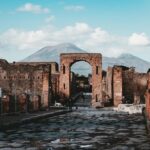
You’ll likely see Mount Vesuvius as part of the story—because the geography is part of why this eruption was so dramatic. It’s one of those rare places where the views are not scenery-only. They’re history in the background.
The tour ends back at the meeting point, so you don’t have to figure out exit logistics mid-stress.
Porta Marina to the Roman Forum: the core story of Pompeii
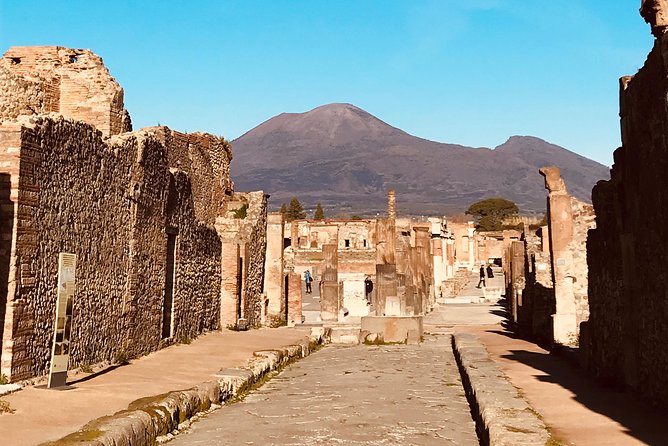
Your first and biggest stop is the Archaeological Park of Pompeii with the entrance ticket included. This is the section where the guide sets the emotional and historical tone: the final moments of the city, the eruption of 79 AD, and how the site was later excavated.
From Porta Marina, the tour follows key public spaces:
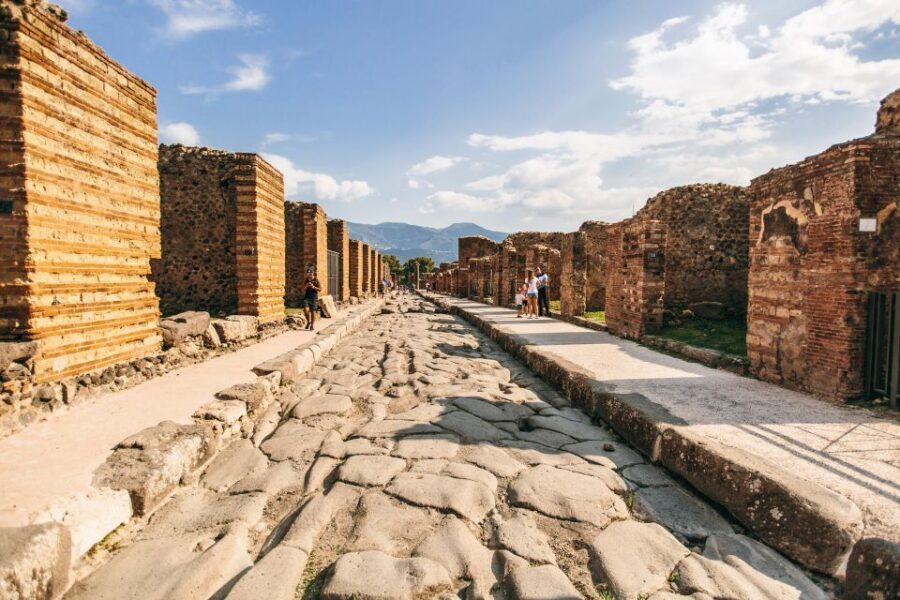
- You’ll walk along the ancient streets and move into the city’s main civic areas.
- You’ll hit the Roman Forum, including major buildings tied to administration and public life.
- You’ll pass through market areas and prominent temples.
- You’ll get a look at how daily routines were organized along main roads like the Decumanus Maximus.
Two highlights here are worth calling out.
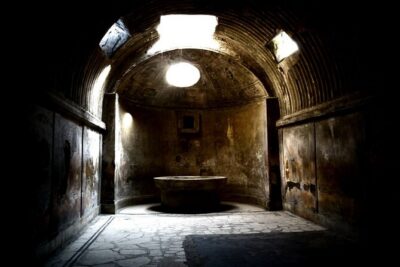
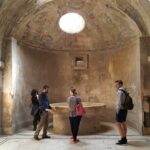
First: the Roman Baths recently reopened. Even if you’ve seen baths elsewhere, Pompeii’s are special because you can picture the flow of people and how hygiene and social life blended. Plus, a reopening means the experience may feel fresher than “just ruins behind a fence.”
Second: the tour focuses on what’s visible now, not what you wish you could see. Pompeii is constantly changing because of preservation work, and a guided route helps you make the most of what’s accessible.
Stop speed vs. learning depth
A possible trade-off with this style is depth. You’re not doing an excavation-process lecture for hours. Instead, you’re learning enough to recognize patterns—public vs private, commerce vs civic, religious rhythm vs everyday commerce. If you want a deep technical talk about the digging methods, plan to add a self-guided read during downtime.
Venus, Apollo, and Jupiter: three temple stops that explain the city’s mind
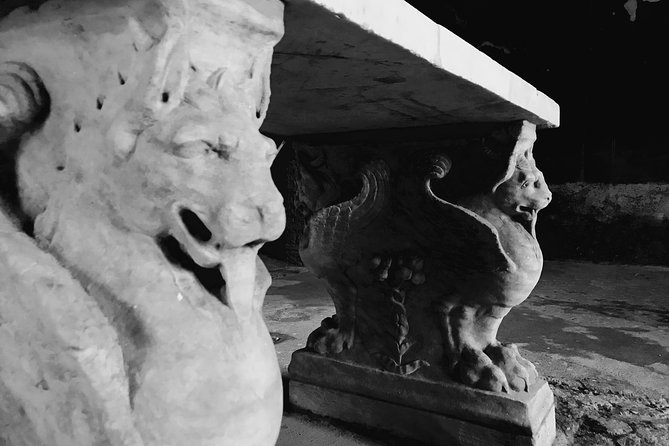
After the main entrance orientation, the tour adds short stops where religion is built into the streets.
You’ll spend about 10 minutes at each of these:
- Tempio di Venere (Temple of Venus): a temple dedicated to Venus, the patron goddess of Pompeii.
- Temple of Apollo (Sanctuary of Apollo): positioned strategically along the street leading from Porta Marina to the public heart of the city.
- Tempio di Giove Capitolino (Temple of Jupiter): it dominates the northern side of the Forum, with Vesuvius rising behind it.
These may feel quick, but that’s the point. Pompeii can overwhelm you with monuments. Three temple stops give you a “spiritual map” without pulling you away from the main story of civic life and eruption.
If you love Roman culture, this section is also a fast way to learn how architecture signals power and identity. Temples aren’t just religious buildings; they’re landmarks of who mattered and what the city valued.

The Forum’s buildings and baths: where business met daily routine
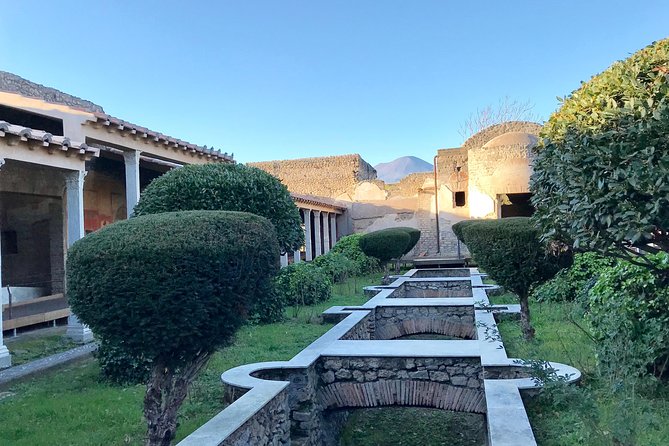
The tour keeps returning to the Forum zone for a reason. This is where public life happened, and it’s where you can connect buildings to roles.
You’ll visit:
- The Basilica: a major building in the Forum used for business management and the administration of justice.
- Terme del Foro (Forum Baths): among the best-preserved elements, with separate entrances for female and male areas.
That “separate entrances” detail is one of those practical clues that makes Pompeii feel real. It hints at routines, rules, and social structure. When you see the layout after hearing that explanation, it becomes less abstract. You start picturing who went where and why.
If you’re the type who likes to understand how people used space, you’ll appreciate this stop sequence. It’s not just big architecture. It’s city choreography.
Macellum and plaster casts: seeing commerce and the tragedy in the evidence
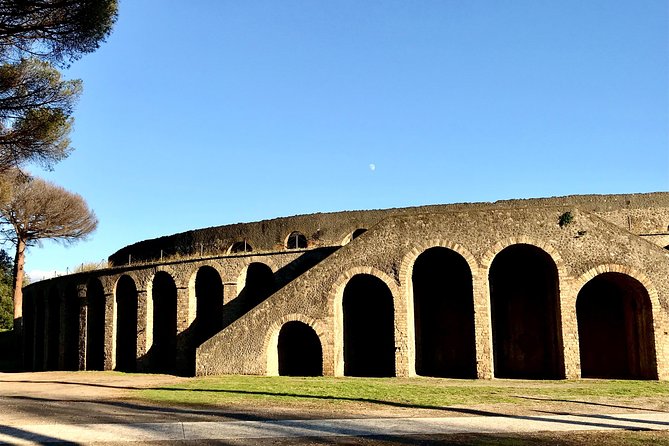
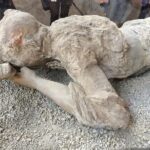
Next comes the Macellum, a monumental food market and consumer-products hub. You’ll also see plaster casts of bodies, an archaeological method used to reconstruct people as they were at the moment of the eruption.
This stop hits hard, but it’s also one of the most educational ones. You get two layers in one place:
- The practical side: food, trade, and daily needs.
- The human side: what the eruption looked like at street level.
It’s one of the few moments where Pompeii stops feeling like “ancient city sightseeing” and becomes “evidence.” The guide can also keep the tone respectful, which matters for a subject like this.
If you tend to get emotional at historical sites, I’d still keep this stop in your must-see list. Skipping it is like visiting a museum without reading the labels.
Houses, shops, and Via dell’Abbondanza: how wealth and everyday life shared the same streets
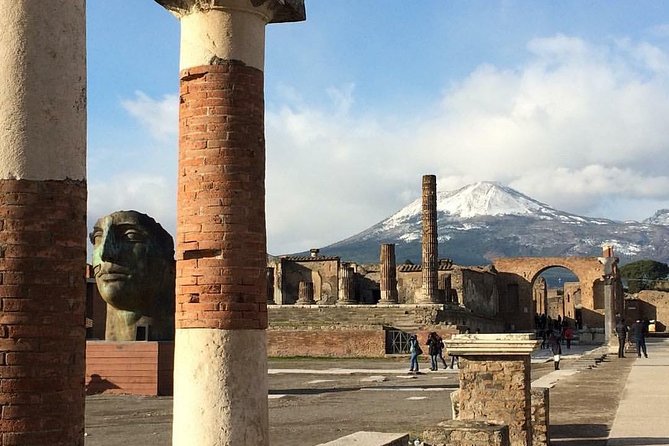
The tour then shifts from public spaces to how people ate, shopped, and lived—less dramatic, but more revealing.
You’ll walk along Via dell’Abbondanza, the ancient main street (the Decumanus Maximus). This is where the “daily Pompeii” feeling clicks. The street layout helps you imagine movement: deliveries, pedestrians, local errands, and the constant flow of commerce.
Shopping and street-life stops include:
- Thermopolium di Vetuzio Placido: essentially an old diner, a place to grab refreshment.
- Roman shops tied to food like thermopolia and bakeries (you’ll see examples as you move through the route).
- House of the Faun: one of the largest houses in Pompeii, with a welcome inscription on the sidewalks in Latin: HAVE.
- House of the Vettii: one of the richest and most famous houses, placed under the protection of Priapus, god of prosperity.
These home stops are short, but they’re chosen well. You get a contrast: a major household and another high-status home, both showing how wealth turned into art, symbols, and street-facing status.
A note on domus and seasonal access
Some of the homes and areas can be subject to seasonal openings and closings. That means what you’ll see may vary slightly based on the time of year. The guided route helps you hit the core spaces that are open, and it also prevents you from arriving at a closed doorway with no plan.
Theatres and gladiator-era spaces: entertainment and power in stone
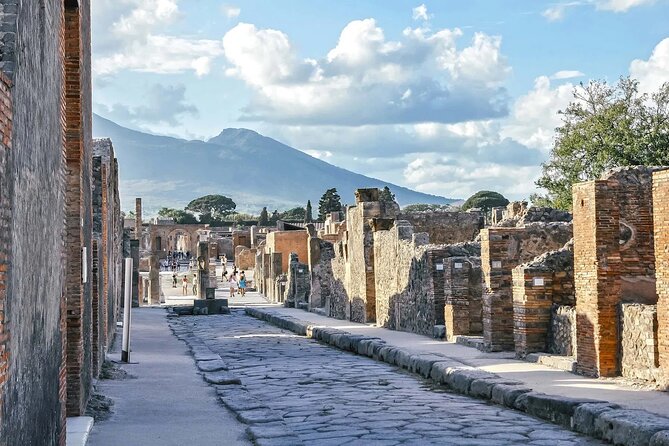
Two more “story pieces” round out the tour:
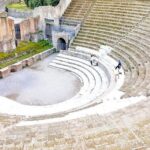
- Large and Small Theatres: you’ll learn how performances in the Greco-Roman tradition worked, including comedies and tragedies.
- Gladiators’ Barracks: a reminder that spectacle and violence were part of public life.
You don’t stay long at each stop, but that’s enough for recognition. You’ll be able to look around and understand the purpose of the buildings instead of just thinking, Nice amphitheatre.
If theatre and entertainment were your favorite parts of Rome tours, you’ll probably enjoy how Pompeii links entertainment to the same city grid as baths, markets, and temples.
Pacing, uneven ground, and how to make this tour comfortable
Pompeii is a walking tour. Even with short blocks, you’ll move a lot through uneven terrain.
Here’s how I’d handle it:
- Wear grippy shoes. Curb edges and stepping stones can catch your foot.
- Bring a small daypack if you have one. You’ll likely be holding onto water and anything you want handy.
- Use the headset if you’re provided one due to crowds. It makes explanations actually usable, not just background noise.
You also get a bit of self-exploration built in. In practice, this can be the best way to absorb what you just learned: you can circle back to details the guide pointed out, then move on.
One extra practical tip: some sites can have limited evening hours. If you’re trying to pack in other plans the same day, keep your timing flexible enough to handle closures near the end of the day.
Price and value: is $66 a fair deal?
At $66.01 per person for about 2 hours, the big value is the mix of things you’d otherwise pay for or wrestle with.
You’re getting:
- Pompeii site admission included
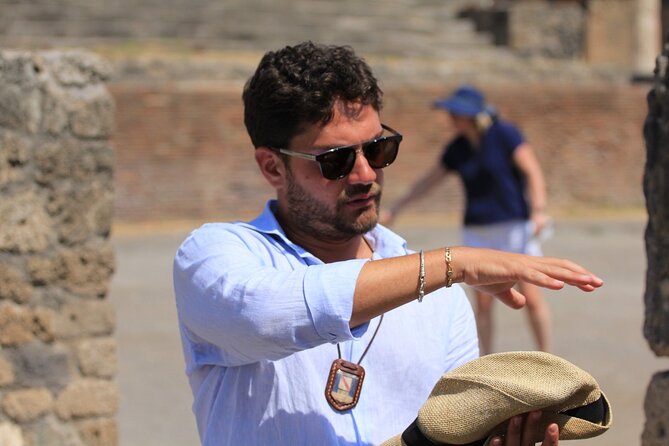
- An authorized guide / archaeologist
- A headset in crowded conditions
- A Pompeii paper map
If you’ve ever bought admission and then tried to navigate alone, you know the problem: Pompeii is too big for your brain to turn it into a coherent story. Paying for a guide here is what turns scattered ruins into a connected visit.
Also, small group size helps. With a max of 15 travelers, you’re more likely to hear the guide clearly and keep your place in the route.
Only you can decide if 2 hours feels short. My take: for a first Pompeii visit, short and focused usually beats long and confusing.
Guide quality is the real upgrade
The itinerary does a lot right. But the guide is what makes it feel alive.
From named guides in reviews, you’ll find the style people praised: guides like Livio, Antonio, and Riccardo were described as passionate, enthusiastic, and good at setting a pace that works. One guide, Ornella, was noted as engaging and expert. Annalisa was praised for being patient and detailed, especially about small details of Roman daily life.
Even better, the more practical part of their job shows up in the responses people shared. One guide helped people find the exit when they had to leave early for transport. That kind of calm, real-world help matters.
So if you care about storytelling that connects architecture to living habits, this is the kind of tour that can pay off more than you expect.
Who should book this Pompeii small-group tour
This tour is a strong match if:
- You’re visiting Pompeii for the first time and want major highlights with context.
- You want a small-group feel without losing the benefits of a structured route.
- You like learning from someone who can explain the “why,” not just point at “what.”
- You want the human story tied to the city layout, including the plaster casts at the market area.
It’s also a decent choice if you’re short on time. Two hours won’t make you an expert, but it will make Pompeii make sense.
Should you book? My straight answer
Book it if you want Pompeii to feel readable. The admission included, the small group size, and the guide-led structure are the winning combination.
Skip it only if you already know Pompeii well and specifically want hours focused on excavation technique or deep comparisons inside a single zone. This tour is designed for breadth and clarity, not for one-stop-by-one-room obsession.
If you do book, go in with one goal: walk away understanding the city’s public life and what happened during 79 AD. That’s the heart of this experience, and it lands well.
FAQ
How long is the Pompeii Tour & Admission in a Small Group?
It runs for about 2 hours.
Is Pompeii admission included in the price?
Yes. The admission ticket to the Archaeological Park of Pompeii is included.
What’s the maximum group size?
The tour has a maximum of 15 travelers.
What language is the tour offered in?
The tour is offered in English.
Do I get a headset for the tour?
You’ll get a headset if the site is crowded.
Where does the tour start?
The meeting point is the Villa of the Mysteries, via Villa dei Misteri, 2, 80045 Pompei NA, Italy.
Where does the tour end?
The activity ends back at the meeting point.
Does the tour include a paper map?
Yes. A Pompeii paper map is included.
Do I need to bring bottled water?
Bottled water is not included.
Which stops are included besides the main Pompeii park entrance?
The tour includes short stops such as Tempio di Venere, the Basilica, the Sanctuary of Apollo, the Forum, the Temple of Jupiter, the Macellum (with plaster casts), Forum Baths, a thermopolium, houses including the House of the Faun and House of the Vettii, Via dell’Abbondanza, and the Teatro Grande.