REVIEW · SORRENTO
Skip the Line Pompeii Guided Tour from Sorrento
Book on Viator →Operated by Acampora Travel · Bookable on Viator
Pompeii in half a day beats the usual slog. This skip-the-line guided trip from Sorrento gives you air-conditioned bus transport, an English-speaking guide, and headsets so you can actually hear the story while you walk. I love the focus on the big, meaningful parts of Pompeii instead of random wandering, and I especially like how the visit is paced with short stops that keep the whole route moving.
Two standouts for me: the guided walk through the Forum complex (civic life, justice, markets) and the inclusion of major everyday-life areas like the Stabian Baths. One consideration: the site has uneven ground, so this isn’t a great fit if you use mobility aids or need step-free paths.
In This Review
- Key highlights you’ll feel right away
- Why Pompeii from Sorrento fits your schedule (and sanity)
- Skip-the-line entry, headsets, and what’s actually included
- Pompeii Archaeological Park: the Forum is where the city makes sense
- Teatro Grande: using the hillside for a Roman stage
- Foro de Pompeya and the pulse of daily public life
- The Basilica: justice and commerce under one roof
- Macellum: Pompeii’s food market and imperial-cult hints
- Stabian Baths: how Romans handled everyday hygiene and heating
- Granai del Foro: storage, daily trade, and what excavations preserve
- Pacing, crowds, and group size: what you can expect in real terms
- Price and value: what $107.17 buys you (and why it’s not just the bus)
- Pickup in Sorrento: traffic reality and how to avoid stress
- Who this tour suits best (and who might not love it)
- Should you book this Skip-the-Line Pompeii tour from Sorrento?
- FAQ
- Is the Pompeii entry ticket included?
- Will I have an English-speaking guide and can I hear them during the walk?
- How long is the tour?
- Does the tour include transportation from Sorrento?
- Is this tour suitable for people with mobility issues?
- Is a meal included?
Key highlights you’ll feel right away
- Skip-the-line style entry with a real guided structure once you’re inside Pompeii
- Headsets during the walking tour so your guide stays clear, even in a crowd
- Forum first, then daily life: from public buildings to baths and storage areas
- Good group cap (max 30 travelers; up to 30 per guide) for questions and a calmer pace
- Air-conditioned bus from Sorrento with live commentary on the ride
- “Main hits” without a food stop (no meal included, so you’ll plan your own)
Why Pompeii from Sorrento fits your schedule (and sanity)
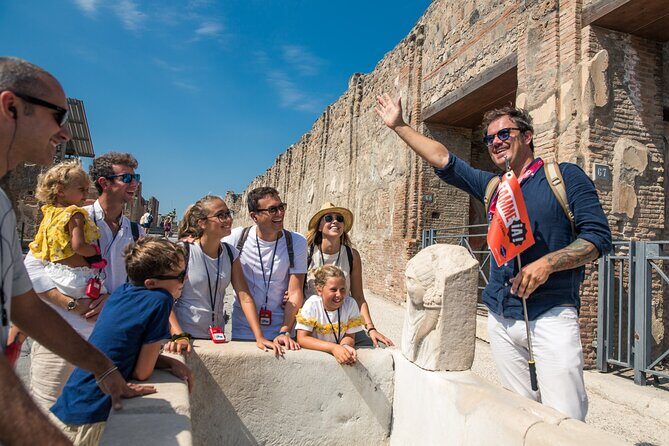
If you’re staying in Sorrento, getting to Pompeii can eat a whole day if you go DIY. This half-day format is the sweet spot: you get bus transport, a guided route, and enough time to see the most important parts without feeling like you’re sprinting.
I like that the tour is built for real time constraints. You’re not expected to master Pompeii on your own. Instead, you’re handed a path through the Forum, the theatre, the key public buildings, and two areas that show Roman daily life beyond the temples.
Also, Pompeii gets busy. Even in calmer seasons, the ruins don’t turn into a quiet museum. A guided plan helps you move efficiently, so you’re not stuck staring at buildings that don’t quite connect in your head.
Other guided Pompeii tours we've reviewed

Skip-the-line entry, headsets, and what’s actually included
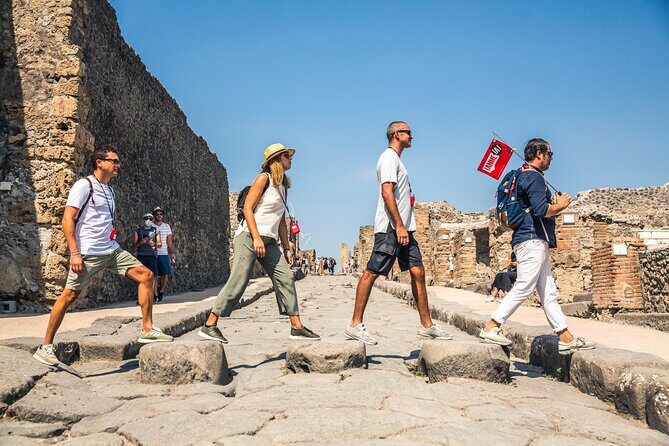
Here’s what you can count on before you even arrive:
- Pompeii entry ticket included
- English-speaking guide through the site
- Headsets during the walking tour
- Transportation by air-conditioned bus
- Live commentary on board
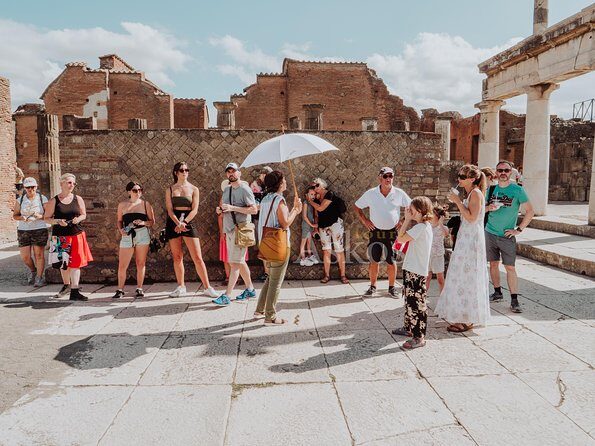
That headset piece matters more than people think. Pompeii is noisy in the practical sense—foot traffic, overlapping conversations, and constant movement. With headsets, you don’t keep losing your place every time the crowd thickens.
You’ll also appreciate that the tour includes the Pompeii admission as part of the package. That keeps your planning simple and reduces the chance of wasting time on the ground.
What isn’t included is equally important for decision-making: there’s no meal and no drinks in the tour price. Plan to snack before you go or grab something after. If you need a bathroom or a drink during the day, you may find small purchases on-site, but budget for it separately.
Pompeii Archaeological Park: the Forum is where the city makes sense
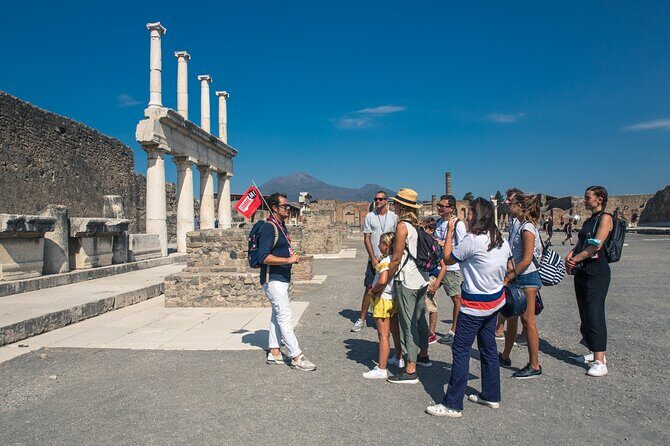
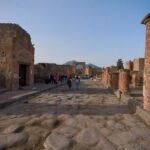
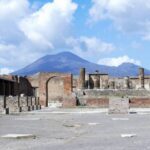
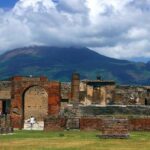
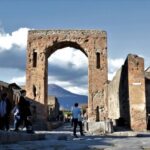
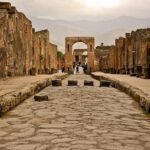
The big anchor of the itinerary is Pompeii Archaeological Park, with about two hours dedicated to the Forum area first. This is the part where Pompeii stops being “cool ruins” and starts feeling like a real city.
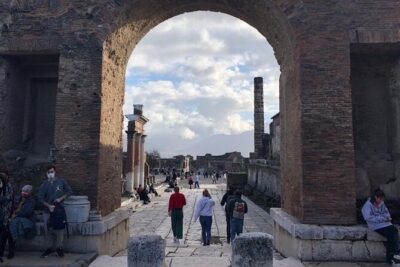
Your guide will lead you through the Forum, Pompeii’s civic heart, surrounded by important public buildings. This section is designed to give you the skeleton of Roman civic life:
- The Basilica (business and justice)
- The Temple of Jupiter
- The Macellum (food market)
This is also where you learn how the city worked day to day. The Forum wasn’t just for ceremonies—it was where administration happened, trade flowed, and public worship took place. When your guide points out connections like this, you start seeing the layout as a system, not a pile of stone.
If you’re the kind of traveler who wants meaning (not just photos), this part is worth the effort. The Forum route is the fastest way to get your bearings fast once you’re inside.
Teatro Grande: using the hillside for a Roman stage
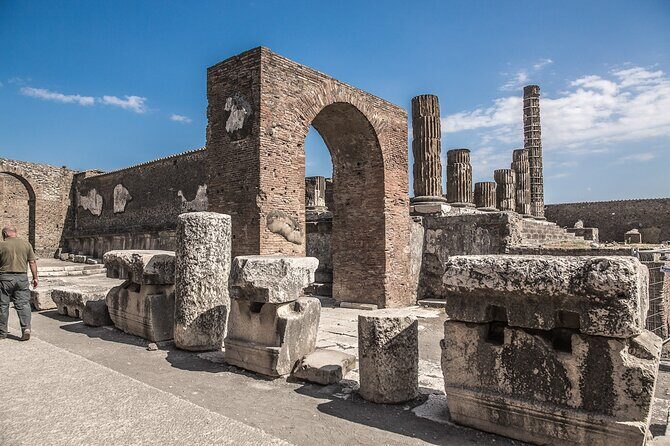
From the Forum, the tour moves to Teatro Grande (the Large Theatre). You’ll spend about 10 minutes here, which sounds short—until you remember the overall tour is half a day.
What makes this stop interesting is the architecture. The theatre was built by exploiting the natural slope of the hill, so the structure fits the landscape in a very Roman way. The staircase was organized into separate areas, corridors, and sectors, plus an access passage with a barrel vault.
This stop also gives you a break from the densest cluster of ruins. You get a different feel: public entertainment, engineering, and design all at once.
Foro de Pompeya and the pulse of daily public life
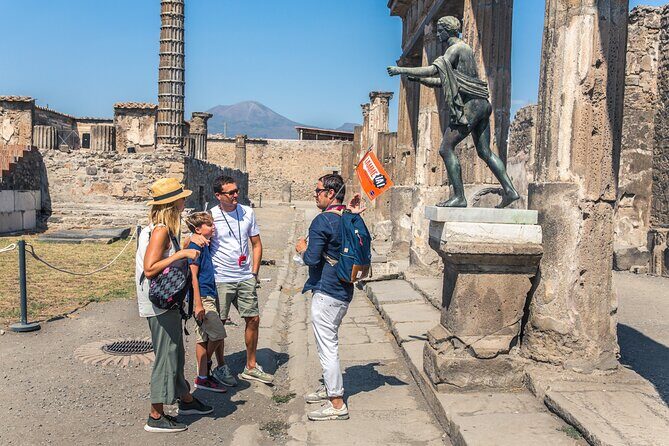
Next is the Foro de Pompeya, again framed as the core of daily life. You’ll get a quick 10-minute window, so think of this as a reinforcement stop—your guide ties together what you’ve already seen and points you toward the main functions of the space.
This is the “focal point” concept: city administration and justice, business and trade (including markets), and public places for citizen worship. It’s a practical stop because it helps you interpret what you already walked through. Without this kind of framing, you can end up walking right past the most important spaces and missing the point.
Other skip-the-line Pompeii tickets and tours

The Basilica: justice and commerce under one roof
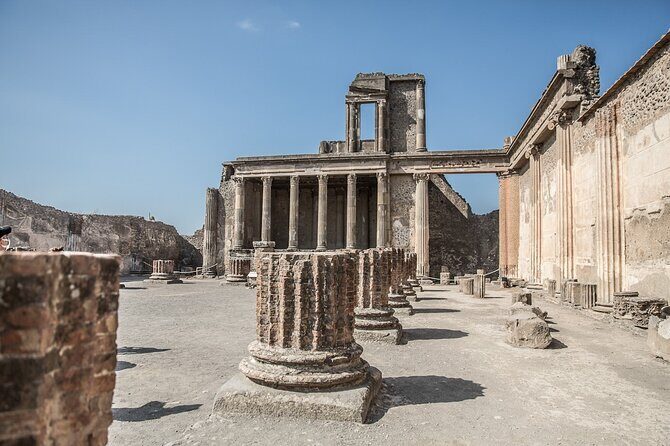
The itinerary then highlights the Basilica, the Forum’s most impressive building. You’ll spend about 10 minutes, but don’t let that fool you. This is one of those places where a quick, well-timed explanation makes the building click.
The Basilica’s scale is described as about 1,500 square meters and it functioned as space for business and administration of justice. You’ll also see structural details:
- Access through five entrances separated by tuff pillars
- An interior divided into three naves
- Two rows of brick columns with Ionic capitals
- A suggestum where judges sat, centrally located on the western side
This is exactly the kind of stop that benefits from a guide. Even if you’re good at reading ruins, it’s hard to connect “this room” with “that civic function” without someone pointing it out.
Macellum: Pompeii’s food market and imperial-cult hints
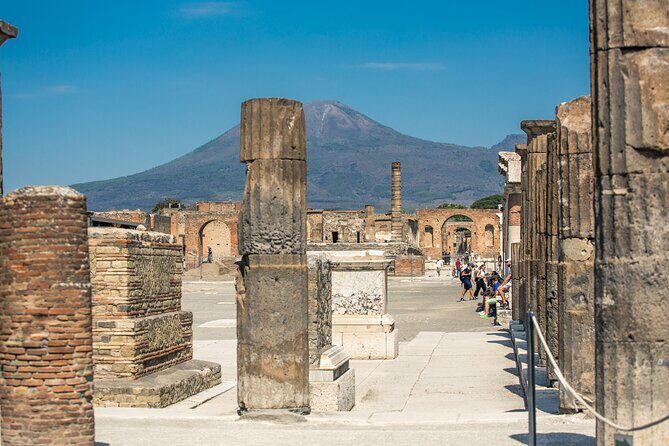
Another short 10-minute stop is the Macellum, the food market. Here, the fun is in the contrasts. You get the market layout, but you also see evidence that commerce and official religion were blended into public life.
You’ll learn the Macellum’s structure as a tuff quadriporticus with a worship hall on the elevated eastern side. There are also references to imperial-cult messaging through statue fragments and niches.
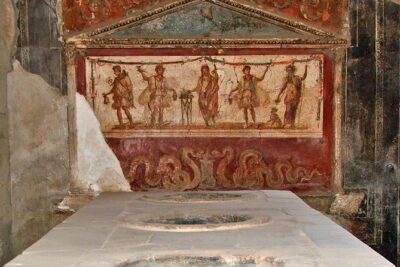
The itinerary notes a room for meetings of a sacred board, plus a larger room with a masonry counter—suggested as a spot where fish could have been sold. That’s the kind of detail that makes the scene feel specific, not generic.
If you like markets and street-level life, this stop gives you a real taste of how Pompeians ate and organized community spaces.
Stabian Baths: how Romans handled everyday hygiene and heating
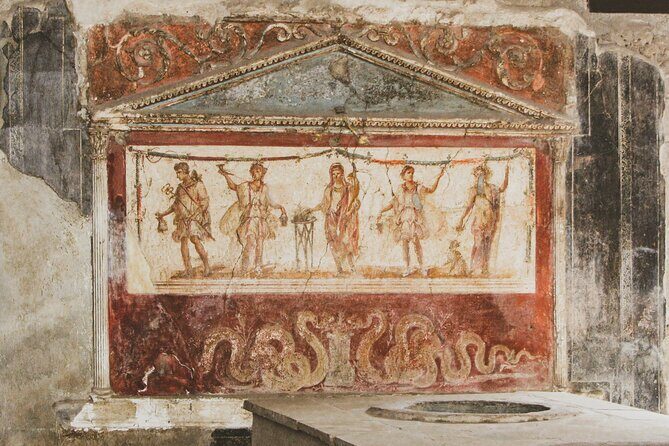
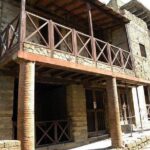
The tour includes the Stabian Baths (Terme Stabiane), dating back to the 2nd century BC. You’ll spend about 10 minutes here, but it’s one of the most effective stops for understanding daily routine.
Why it’s a highlight: baths were a core social habit, and these are among the oldest Roman-world bath complexes we know of in this form.
Your guide will walk you through the layout:
- Main entrance via via dell’Abbondanza into a courtyard
- A pool to the left
- A colonnade to the right leading toward men’s quarters
- Rooms moving from dressing into cold baths (frigidarium), then medium (tepidarium), then hot (calidarium)
The heating system is a big story here. You’ll hear about piping in the walls and double floors that circulated hot air from furnaces and braziers. If you’ve ever wondered how Roman “warmth” worked in practical terms, this stop answers that question fast.
Granai del Foro: storage, daily trade, and what excavations preserve
The last Pompeii highlight is the Granai del Foro, located on the western side of the Forum. You’ll get about 10 minutes here.
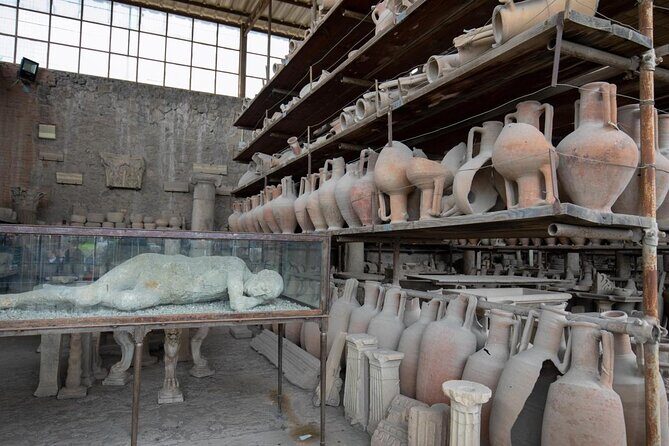
These were used as a fruit and vegetable market (Forum Holitorium), but what makes this stop valuable today is what the excavations have left behind. The Granai preserve a major archaeological inventory—more than 9,000 artifacts collected from Pompeii and surrounding territory since the late 1800s.
You’ll see the sense of everyday scale: terracotta crockery like pots, pans, jugs, bottles, and amphorae for carrying oil, wine, and fish sauce. This is the kind of information that changes how you look at the rest of Pompeii. Suddenly, it isn’t only about grand architecture. It’s about food supply chains and daily cooking.
Pacing, crowds, and group size: what you can expect in real terms
This tour is built for a manageable group. It caps at 30 travelers, and the archaeological-site portion is described as up to 30 pax per guide. That matters because it affects two things you’ll feel immediately:
1) how well you can hear your guide
2) how easy it is to ask questions without being lost in a crowd
The itinerary moves through several major areas with short time allocations at some stops (often 10 minutes). That can feel intense if you prefer unhurried exploration. But it works because the stops are logically sequenced—Forum core first, then theatre, then more civic/public spaces, and then daily life areas.
One practical note from real-world pacing: return trips can include multiple stops around Sorrento. If you’re planning your evening, leave some buffer.
Price and value: what $107.17 buys you (and why it’s not just the bus)
At about $107.17 per person, this isn’t a bargain-bucket deal. The value is in what’s folded in:
- Admission to Pompeii
- Guided route through key areas
- Headsets, which many cheaper options don’t include
- Air-conditioned bus with live commentary
So you’re not paying only for transportation. You’re paying for guided context that helps you connect spaces across Pompeii in limited time.
Also, the tour has strong timing discipline. It’s approximately 4 to 5 hours, which lines up with the half-day need for many Sorrento visitors. For visitors who want to see Pompeii without losing an entire day, this pricing can make sense.
If your priority is maximum freedom to wander and you speak fluent Latin-flavored history, DIY might feel cheaper. But if you want Pompeii to make sense quickly, the package value improves fast.
Pickup in Sorrento: traffic reality and how to avoid stress
One part of this experience that deserves your attention is pickup. Pickup is offered, but Sorrento has traffic restrictions zones, so timing and meeting points matter.
Pickup starts 45/30 minutes before departure. You’ll need to be ready at the meeting location, and you should confirm the exact pickup time and location with the supplier before you go. You also have to tell them which meeting point you’re using.
In real life, this is where tours can go sideways—delays, no-shows, or confusion when people arrive late. The tour notes that the supplier isn’t responsible if you don’t communicate to arrange pickup time/location. So treat pickup like an appointment: show up early, confirm details, and keep your expectations realistic about traffic.
Who this tour suits best (and who might not love it)
This experience is best if you:
- want guided context fast
- prefer a structured route through the biggest Pompeii highlights
- like being in a group that’s small enough to stay oriented
- want the convenience of bus transport from Sorrento
It’s less ideal if you:
- have mobility limitations, because the site has uneven surfaces
- need long stops to soak in one place at a time
Language-wise, it’s offered in English, and the guide delivers the walking tour with headsets, which helps with comprehension even when crowds rise.
One more practical tip: if you’re interested in what excavators are working on today, you might catch glimpses when your guide points out areas with excavations in progress. A guide named Carmela was specifically praised for adding that kind of detail into the experience.
Should you book this Skip-the-Line Pompeii tour from Sorrento?
I’d book it if you want Pompeii to feel like a city, not just a photo stop. The pairing of the Forum complex, the Basilica, the Macellum, and then everyday-life sites like the Stabian Baths and Granai del Foro is the right mix for a half-day tour.
Choose a different option only if you need maximum mobility support or you want long, slow time in fewer areas. With this format, the tradeoff is clear: you’ll see a lot of major ground, but you won’t have hours to linger in one corner.
If you’re balancing value, convenience, and a guided path that actually helps you understand what you’re looking at, this tour checks those boxes.
FAQ
Is the Pompeii entry ticket included?
Yes. The tour includes a Pompeii entry ticket as part of the package.
Will I have an English-speaking guide and can I hear them during the walk?
Yes. You’ll have an English-speaking guide through the site, and you’ll be provided with headsets during the walking tour.
How long is the tour?
It’s listed as approximately 4 to 5 hours, depending on local traffic and unforeseen circumstances. The visit at Pompeii is split across multiple stops.
Does the tour include transportation from Sorrento?
Yes. The tour includes transportation by air-conditioned bus, and pickup is offered. Pickup time starts 45/30 minutes before departure, and you must confirm the exact pickup time and location.
Is this tour suitable for people with mobility issues?
No. The tour notes that it is not suitable for people with mobility problems due to uneven surface conditions.
Is a meal included?
No. Meal and drinks are not included in the tour price.