REVIEW · POMPEII
Fast Access Exclusive Private Ancient Pompeii Herculaneum & Oplontis Guided Tour
Book on Viator →Operated by Private Tours of Pompeii · Bookable on Viator
Three ancient cities, one morning start.
This private tour ties together Pompeii, Herculaneum, and Oplontis into a single day with priority admission so you spend less time in line and more time actually seeing the places. I also like that it’s truly private, so you can move at the pace your guide sets. A possible drawback: with a full day and several stops, some sights get a focused highlight visit rather than hours of wandering.
What makes this tour especially satisfying is the way it compares sites that people often lump together. Pompeii shows the big story in the biggest setting, Herculaneum has a different feel street-to-street, and Oplontis (with the Villa Poppea area) adds a household angle to the tragedy. One more thing to keep in mind: transportation to and from attractions isn’t included, so you’ll want to confirm how you’ll move between sites after meeting.
And if you end up with a guide like Loretta, that’s a strong sign. She’s specifically named as exceptional in feedback—serious knowledge, plus a tour style that stays interesting instead of turning into a lecture you can’t escape.
In This Review
- Key highlights you’ll feel on the ground
- Fast access across Pompeii, Ercolano, and Oplontis
- The 9:00 am start: where you meet and how the day ends
- Stop 1: Scavi di Oplontis and Villa Poppea highlights in about an hour
- Stop 2: Pompeii Archaeological Park in roughly 2 hours, plus three focused sights
- A practical Pompeii tip
- Stop 3: Herculaneum (Ercolano) and the street-level feel of daily life
- How a private guide changes what you notice
- Why the UNESCO triple-combo feels like real value
- Price check: is $411.55 per person reasonable?
- Dress code, tickets, and the kind of traveler who’ll enjoy this
- Who should book this private Pompeii–Herculaneum–Oplontis day
- Should you book fast access private Pompeii, Herculaneum, and Oplontis?
- FAQ
- FAQ
- How long is the tour?
- What time does the tour start?
- Where do I meet the tour, and where does it end?
- Is priority admission included?
- Which sites are included in the itinerary?
- What’s included in the price?
- What isn’t included?
- What should I wear?
- Is the tour suitable for kids and accessibility needs?
- Is there free cancellation?
Key highlights you’ll feel on the ground
- Guaranteed priority admission at each stop, so your day starts with momentum
- Private format: only your group, which makes it easier to ask questions and adjust pace
- Three UNESCO sites in one loop across Pompeii, Ercolano, and Torre Annunziata
- A Pompeii hits-and-meaning route through Foro, Teatro Grande, and Casa del Menandro
- Oplontis and Villa Poppea time to connect Roman villas with the bigger eruption story
- A guide-led focus on daily life, not just “here’s a ruin”
Fast access across Pompeii, Ercolano, and Oplontis
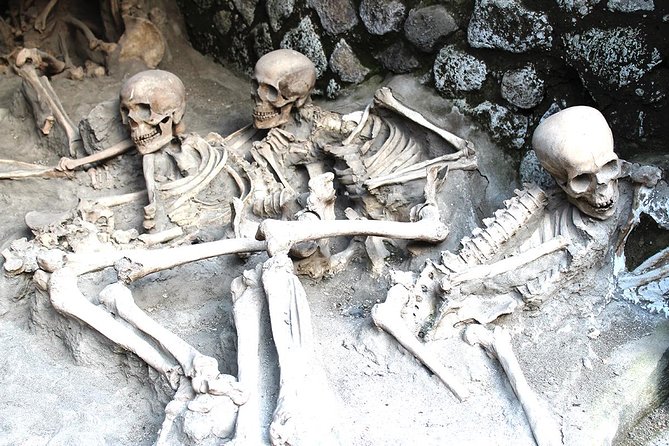
This is one of those days where logistics matter as much as the archaeology. Priority admission is the headline for a reason: Pompeii and its neighbors can mean long queues, and time is the one thing you can’t buy back once you’re standing in a line. Here, you’re paying for a guided route that aims to keep you moving.
The private setup also changes the vibe. Instead of juggling a crowd’s pace, you can linger where something grabs you—like a room layout, a doorway, or a detail your guide points out. If you like asking questions as you go, this format is the difference between seeing a site and understanding it.
The tradeoff is pacing. This is an 8-hour tour that covers three major locations, plus key Pompeii landmarks, so expect “best-of” coverage at each stop rather than total freedom to wander for hours on end.
If you're still narrowing it down, here are other tours in Pompeii we've reviewed.



The 9:00 am start: where you meet and how the day ends
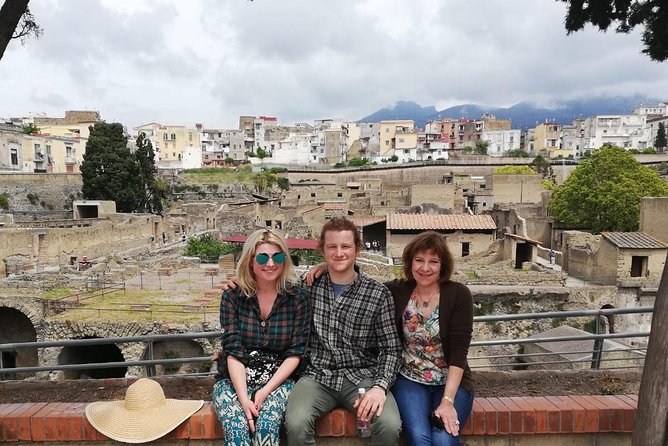
The tour starts at 9:00 am at Piazza Esedra, 80045 Pompei NA. You’ll end at Scavi di Oplontis – Villa Poppea, Via Sepolcri, 80058 Torre Annunziata NA.
That end point detail matters for planning. Since the day finishes at Oplontis, you should arrange your return from Torre Annunziata rather than assuming you’ll circle back to central Pompeii at the same place you started. Also note the tour doesn’t list hotel pickup or drop-off, so you’ll want a clear plan to reach the meeting point.
Because transportation to/from attractions isn’t included, ask ahead about the between-site moves. The itinerary clearly visits different parks, but the “how you travel between them” isn’t spelled out in the provided details. A quick question to the operator can save you from scrambling later.
Stop 1: Scavi di Oplontis and Villa Poppea highlights in about an hour
Your first site is Scavi di Oplontis, for about 1 hour, with admission included. Oplontis is often less crowded than Pompeii itself, and that’s part of the appeal. You get an easier entry into the larger story of AD 79 while still seeing real residential life.
The major draw here is the villa setting—Villa Poppea is the name that shows up with this stop. A guided visit at Oplontis works well because it shifts your perspective from streets and public life to how wealthy Romans lived at home. Even with limited time, you’ll likely come away with a stronger sense of how these households were organized and used.
If you’re the type who likes comparison days (instead of repeating the same ruins in three forms), Oplontis is a smart opener. It frames the day so Pompeii and Herculaneum feel like chapters, not separate stops.
Stop 2: Pompeii Archaeological Park in roughly 2 hours, plus three focused sights
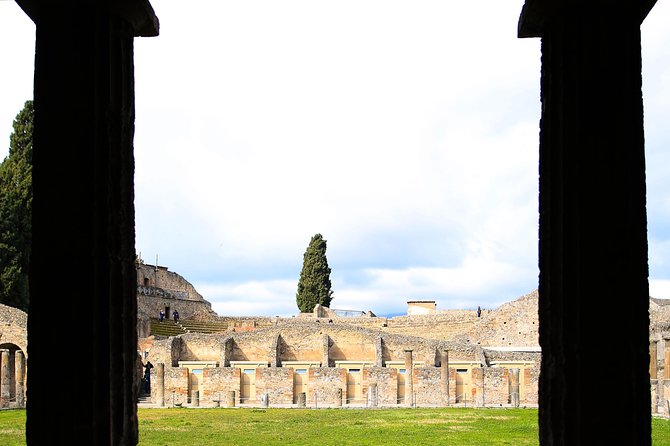
Pompeii gets about 2 hours total at the Pompeii Archaeological Park, but within that window you hit specific highlights that explain the city’s structure.
Here’s what you see:
- Foro de Pompeya (15 minutes), the main square
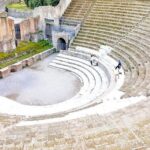
- Teatro Grande (15 minutes), the main theater with its standout acoustics
- Casa del Menandro (15 minutes), a typical Pompeian domus with frescoes, calidarium, rooms, and a private garden
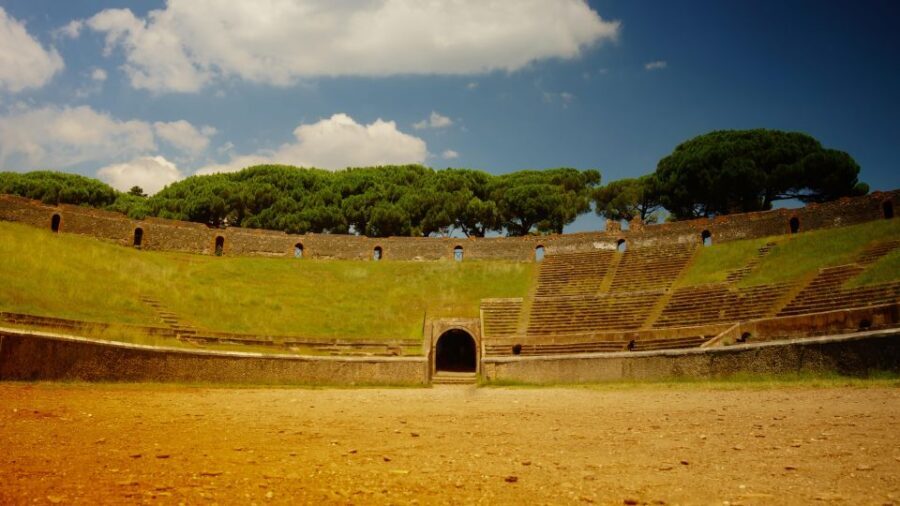
Pompeii is described as the largest archaeological site in the world, and walking it with context helps that scale stop feeling overwhelming. The Foro gives you the civic backbone. It’s where the city’s public life would have felt concentrated—ideal for your guide to connect everyday rhythms to what you’re seeing in stone.
Then comes Teatro Grande. The time you spend there matters because theater in a Roman city wasn’t just entertainment; it was social glue. If you pay attention to how the space works, you’ll start understanding why the structure and design were so important.
Finally, Casa del Menandro is where “daily life” becomes real. A domus is a great bridge between the public city and the private one. You’ll get a snapshot of rooms, wall painting (frescoes), and spaces tied to bathing and daily routine—plus the idea of a private garden, which is a nice human detail that pulls you out of disaster-only thinking.
A practical Pompeii tip
Wear shoes that handle uneven ground and small stair steps. Even when a stop is only 15 minutes, Pompeii tends to ask for attention underfoot. If you have moderate physical fitness, plan on comfortable walking and short bursts of climbing.

Stop 3: Herculaneum (Ercolano) and the street-level feel of daily life
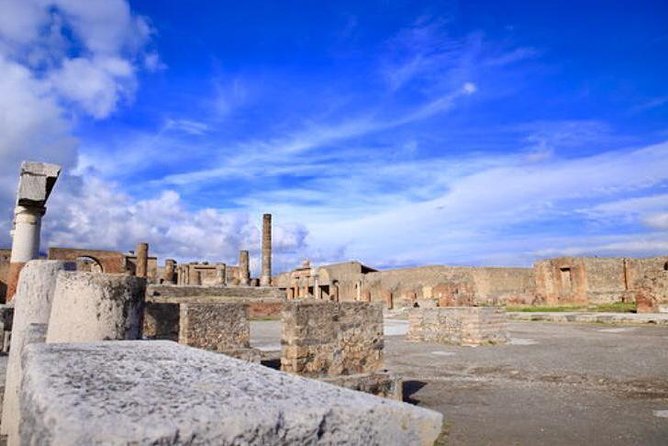
You’ll spend about 2 hours at Parco Acheologico di Ercolano. Herculaneum’s power is in how “city” it feels even as a site. It’s not only ruins; it’s a place where you can imagine the layout and the movement of people.
This part of the day is where the tour’s daily-life focus really pays off. Pompeii often hits like an enormous story—big scale, dramatic scenes. Herculaneum tends to feel closer and more intimate, and with a guide, you’ll be pointed at the kinds of details that help your brain map what you’re seeing.
Expect your guide to connect what you observe to Roman routines: how space was used, what different buildings implied, and why certain architectural choices mattered. With a two-hour block, you should have enough time for more than a quick walk-through.
How a private guide changes what you notice
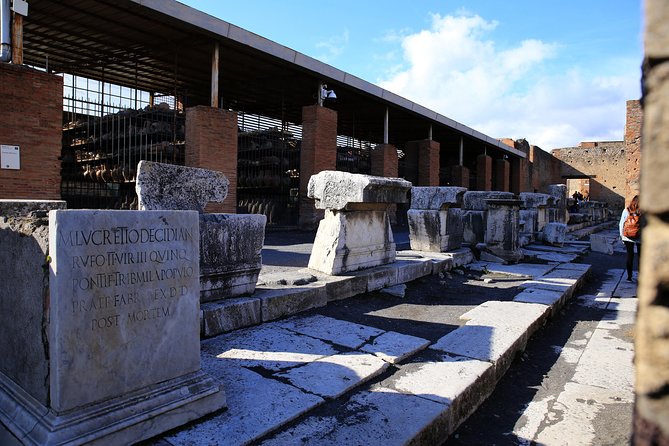
This is one of those tours where the guide is the product, and the guide quality shows in small moments. One of the best signs here is the specific mention of Loretta as exceptional, with broad knowledge and a tour that stays engaging.
Even without getting stuck in technical jargon, a good guide helps you avoid the common trap: standing in front of an ancient wall and thinking, now what? With a guided structure, you learn what to look for:
- how Roman public spaces worked (like the Foro and theater)
- how homes were set up for daily routine (like domus spaces)
- why the sites feel different from each other, even though they share the same eruption event
And because it’s private, you can ask questions as you go. That turns your curiosity into part of the tour rather than something you store for later.
Why the UNESCO triple-combo feels like real value
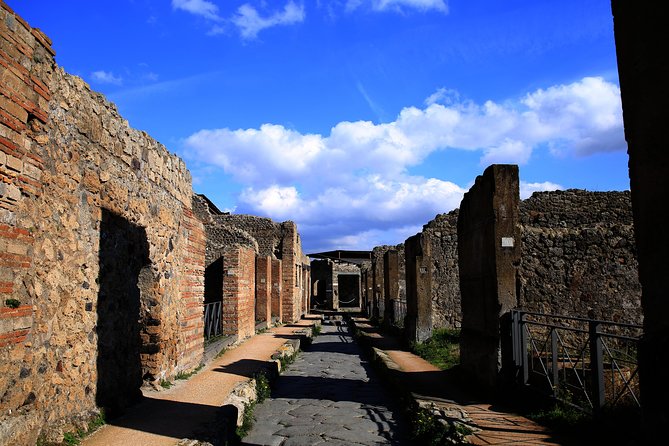
You’re paying for time saved, expertise, and focused route planning across three UNESCO World Heritage sites. The itinerary hits:
- Oplontis (Torre Annunziata)
- Pompeii Archaeological Park
- Herculaneum (Ercolano)
If you tried to assemble this on your own, you’d likely spend extra time buying tickets, figuring out routes, and dealing with longer entry lines—especially at Pompeii. Here, priority admission is included, which is a direct “value you can feel” on the day of your visit.
Price check: is $411.55 per person reasonable?
At $411.55 per person for an ~8-hour private guided experience that includes:
- a professional guide
- entrance tickets
- priority admission to each site
…it’s not a budget deal. But it can be fair value if you care about saving time and getting context rather than just checking boxes.
This price makes the most sense if:
- you’re traveling as a couple or small group where “private” doesn’t cost extra versus a crowded tour
- you hate waiting in lines and want your day to run on schedule
- you want a guide to translate what you’re seeing into something coherent
Also, there are group discounts mentioned, which could improve value depending on your group size.
Dress code, tickets, and the kind of traveler who’ll enjoy this
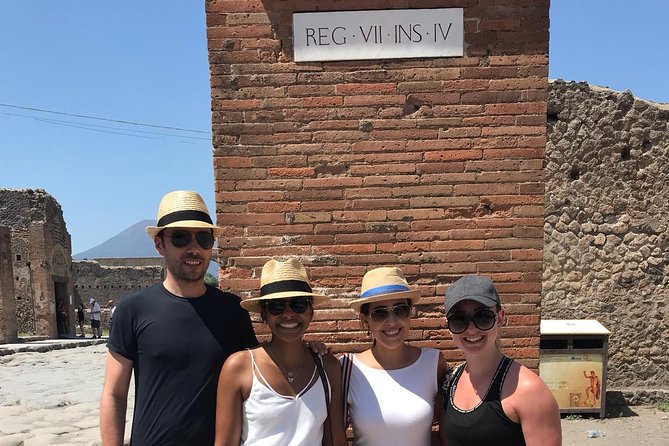
Smart casual is the dress code. You’ll be on your feet, and Pompeii’s ground isn’t designed for fancy shoes, so treat “smart casual” as comfortable-first.
The tour uses a mobile ticket, which usually makes entry smoother and less fiddly the day you arrive. It’s also listed as being near public transportation, which helps if you’re not driving.
This works best for adults and older teens who can handle a moderate amount of walking and uneven surfaces. Since children must be accompanied by an adult, it’s also better for families who don’t mind a structured, adult-paced day.
Service animals are allowed, and that’s good to know if you travel with one.
Who should book this private Pompeii–Herculaneum–Oplontis day
I’d book this if you want the strongest learning-per-hour ratio without wasting time. This tour is built for comparison: different sites, different feels, same eruption event.
It’s also a great choice if you’re:
- short on days and want three UNESCO stops in one go
- the type who learns best through guided explanation, not a self-guided audio trail
- someone who values priority entry because you’ve learned lines can eat half a day in Italy
If you want totally unstructured wandering and long stays at one location, you might find the timed stops limiting. But if you like “guided highlights that make the rest of your visit click,” this schedule is a good fit.
Should you book fast access private Pompeii, Herculaneum, and Oplontis?
If you can handle a full day and you want to avoid entry lines while getting real context, I think this is a smart booking. The priority admission, included tickets, and private guide format are the core reasons to consider it, and the Pompeii focus on the Foro, Teatro Grande, and Casa del Menandro gives your day a clear shape.
The main reason to pause is the transportation uncertainty. Since transportation to/from attractions isn’t included, make sure you know how you’ll travel between stops and how you’ll get from the final drop-off at Oplontis back to where you’re staying. Once that’s sorted, you’re set up for a day that’s both efficient and actually meaningful.
FAQ
FAQ
How long is the tour?
The tour is about 8 hours.
What time does the tour start?
The start time is 9:00 am.
Where do I meet the tour, and where does it end?
You start at Piazza Esedra, 80045 Pompei NA, Italy, and the tour ends at Scavi di Oplontis – Villa Poppea, Via Sepolcri, 80058 Torre Annunziata NA, Italy.
Is priority admission included?
Yes. The tour includes guaranteed skipping of long lines with priority admission to each site.
Which sites are included in the itinerary?
The tour includes Scavi di Oplontis, Pompeii Archaeological Park, and Parco Acheologico di Ercolano, with added Pompeii highlights including the Foro, Teatro Grande, and Casa del Menandro.
What’s included in the price?
Included: a professional guide, priority line skipping, and entrance tickets.
What isn’t included?
Not included: lunch, transportation to/from attractions, and hotel pickup and drop-off.
What should I wear?
The dress code is smart casual.
Is the tour suitable for kids and accessibility needs?
Children must be accompanied by an adult. The tour notes a moderate physical fitness level is recommended, and service animals are allowed. It also states it’s near public transportation.
Is there free cancellation?
Yes, free cancellation is available. You can cancel up to 24 hours in advance for a full refund.