REVIEW · SORRENTO
Skip-the-Line Pompeii Guided Tour from Sorrento
Book on Viator →Operated by IAMME IA! - Gray Line Amalfi Coast · Bookable on Viator
Pompeii makes more sense with a guide. This skip-the-line tour pairs air-conditioned coach comfort with an official Pompeii guide, so you walk in, get oriented fast, and hit the big sights without losing hours. My favorite part is the structure: you cover several key areas in one go, not just a random loop.
You also get help hearing the story while you’re moving, with headphones for larger groups, and a set plan that keeps you from wandering in circles. The main drawback to plan around is pace: you’ll be on uneven ancient stones with steps and inclines, so it’s not the easiest day if your mobility is limited.
In This Review
- Quick hits you can bank on
- From Sorrento to Pompeii: coach comfort and a smooth start
- Skip-the-line entry: why “fast” changes everything
- The Forum and civic life: Civil Forum, Temple of Jupiter, and the Macellum
- Via dell’Abbondanza and the Stabian Baths: street life and Roman routines
- The Lupanar and House of the Faun: the city’s darker corners and big wealth
- Basilica and Teatro Grande: justice, business, and staged drama
- The walking reality: time limits, uneven ground, and photo stops
- Who this Pompeii tour suits best (and who might want a different plan)
- Price and value: what $90.70 buys you
- Should you book this skip-the-line Pompeii tour from Sorrento?
- FAQ
- Where do you meet in Sorrento?
- How long is the Pompeii portion of the tour?
- Is the skip-the-line ticket included?
- Does the price include admission?
- Do you get headphones during the tour?
- Is food and drinks included?
- Can I cancel for a full refund?
Quick hits you can bank on
- Skip-the-line entry so you spend more time inside the ruins than waiting at the gate
- Round-trip, air-conditioned coach from central Sorrento
- Official Pompeii guide plus headphones in Pompeii for groups over 10
- A tight highlights route covering Forum life, street life, baths, the Lupanar, mosaics, and theater
- Small-ish groups (up to 29), which helps you move as a unit without feeling totally packed
- Time-efficient departures (morning or afternoon), with mornings often feeling cooler and less crowded
From Sorrento to Pompeii: coach comfort and a smooth start
The day starts in central Sorrento at IAMME IA! – Gray Line Amalfi Coast, Piazza Torquato Tasso, 16. From there, you’re on a round-trip air-conditioned vehicle, which matters more than people think. The ride from the coast area into Pompeii is part of the day’s energy budget, and the comfortable coach helps you show up ready to walk.
This isn’t a huge tour in size terms, with a maximum group of 29. That’s big enough to keep logistics simple, but small enough that you can still follow along when the guide points out where to look next. If you’re choosing between morning and afternoon, I’d lean morning when possible, because crowds and heat tend to build during the day.
One more practical detail: you’re not dropped at some far-off entrance. The plan is built to get you to Pompeii efficiently and return you to the same meeting point area back in Sorrento.
Other guided Pompeii tours we've reviewed

Skip-the-line entry: why “fast” changes everything
Pompeii is famously easy to underestimate. The site is enormous, and a long wait can quietly eat your best walking hours. With skip-the-line admission, you head in and start seeing instead of queueing.
You also get a guided structure that helps you prioritize. Without that help, Pompeii can feel like you’re staring at scattered ruins and trying to guess where the “important bits” are. Here, the guide keeps you moving through the areas that explain how the city worked: public spaces, daily business, private homes, and the entertainment that structured Roman life.
Because the highlights are time-managed, you’ll likely want to take photos early and often. You’ll still have moments to pause, but this is not a slow, roam-at-will day.
The Forum and civic life: Civil Forum, Temple of Jupiter, and the Macellum
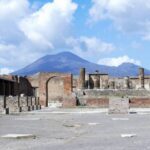
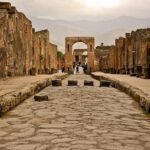
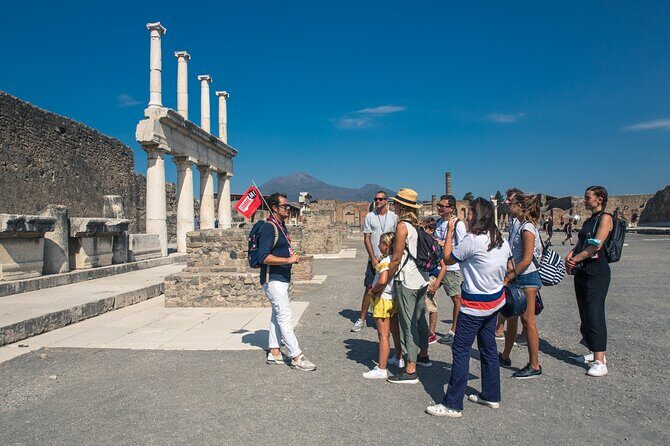
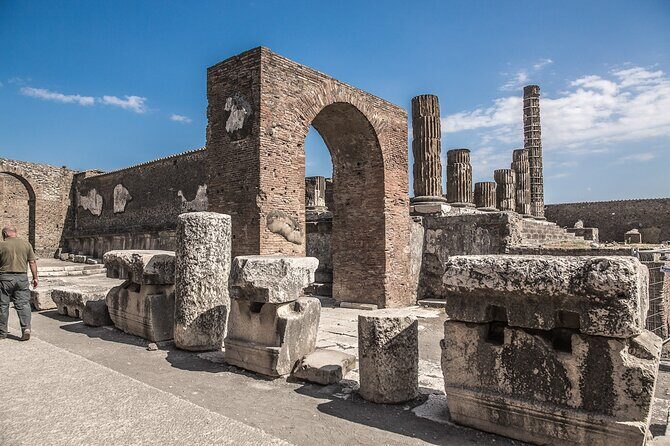
Your visit begins in the core of Pompeian public life. The Civil Forum is the daily-life hub, where the city handled administration, justice, trade, and worship. This is the part that helps first-timers understand Pompeii as a functioning Roman town, not just a museum of columns.
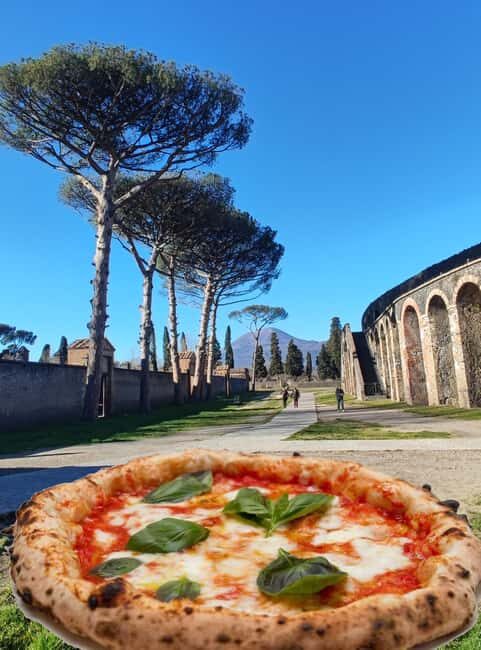
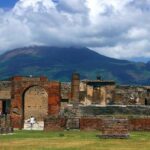
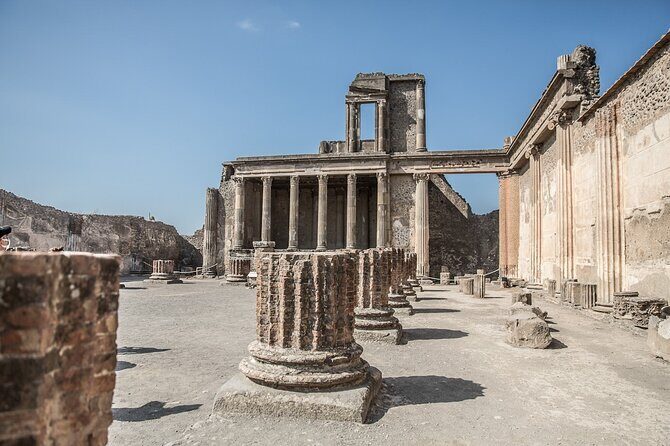
Right here, the Temple of Jupiter anchors the north side of the Forum. What I like about this stop is the visual payoff: Mount Vesuvius sits behind the scene, so you’re not just reading about the eruption story later. The temple also reflects how political power shaped religion, including a major renovation after the colony was founded, with cult statues of Jupiter, Juno, and Minerva placed so they’d be visible to people moving through the Forum.
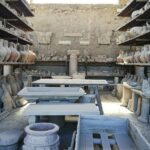
Next you’ll move to the Macellum, the market complex. The details matter: the Macellum was built around a tuff quadriporticus and included worship areas and spaces connected to trade. The guide typically points out how art and architecture signaled imperial connections too, including references to imperial-cult ideas suggested by statuary fragments.
Practical tip: when you’re in the Forum area, slow down just enough to look up and around. Pompeii can make you fixate on ground-level streets, but this zone is built for sightlines—people designed it to be seen.
Via dell’Abbondanza and the Stabian Baths: street life and Roman routines
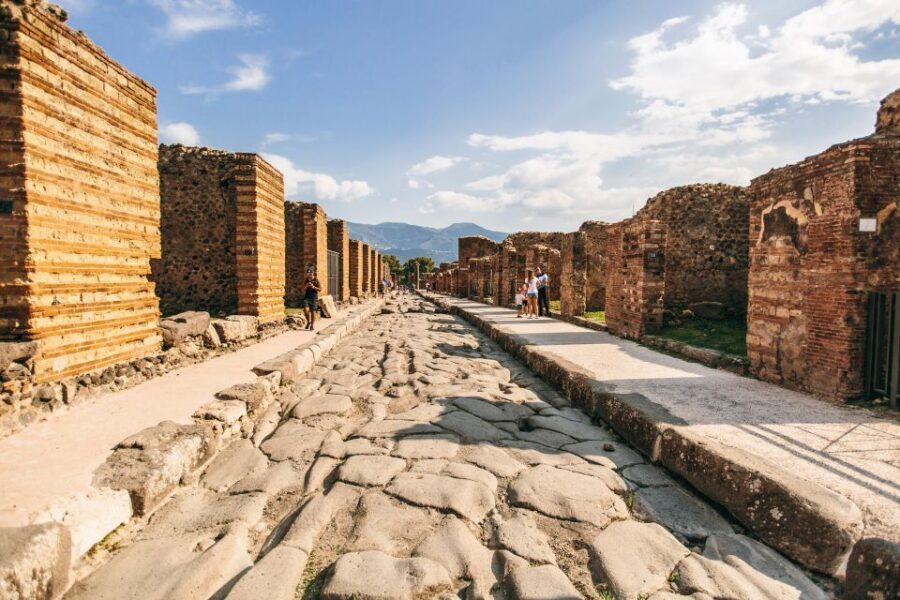
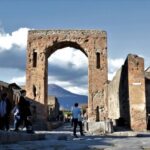
Then the tour shifts from civic power to everyday rhythms. Via dell’Abbondanza was the main street, a decumanus maximus running east-west between the Forum and Porta Sarno. In Roman times, it would have been loud with workshops, cafes, snack-bars, and shops. Standing on this street helps you imagine how movement, business, and social life braided together.
You’ll likely get only a short stop here, but it’s still useful. If you’re going to remember one street as the spine of Pompeii, this is a strong choice.
After that comes the Stabian Baths (Terme Stabiane), located behind the Temple of Jupiter. This stop gives you a peek at Roman self-care and social structure: different rooms for warm, cool, and hot bathing routines, plus dressing areas like an apodyterium. You also see the layout logic—men and women had separate entrances—and you get a sense of the damage pattern, including how the baths were hit by the earthquake of 62 AD.
If you’re touring in warmer months, baths are a mental breather. You still walk, but you’re in a section where you can stop and focus on how the space worked.
The Lupanar and House of the Faun: the city’s darker corners and big wealth
Pompeii has a reputation for shocking you a little, and this route makes sure you feel that edge. The Lupanar is the most famous official brothel in Pompeii, tucked into a narrow side street near the city center. The key reason it’s worth visiting is that it’s preserved in a way that shows design intent: built-in masonry beds in small rooms on a two-story layout.
The most talked-about details are the erotic frescoes above doors and the graffiti left by visitors. It turns the site into something raw and human, not just grand architecture.
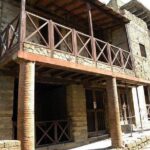
After that, the mood flips. The House of the Faun (Casa del Fauno) is one of Pompeii’s largest and most luxurious private residences, covering an entire city block. The highlight is the famous Alexander Mosaic, a floor mosaic tied to the battle between Alexander the Great and Darius III. If you’re the type who loves craftsmanship, this is a stop that can feel almost modern in how crisp it appears.
The guide will usually point out how the house’s peristyle gardens and mosaic-heavy decoration signaled elite taste and wealth. Even for a short visit, the contrast between the Lupanar and this home makes Pompeii’s social hierarchy hard to forget.
Other skip-the-line Pompeii tickets and tours


Basilica and Teatro Grande: justice, business, and staged drama
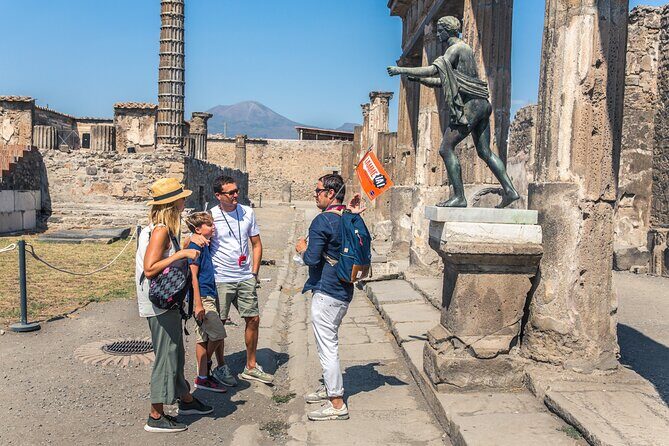
Next you’ll return to public power, through the Basilica. This was the most sumptuous building of the Forum, with an enormous footprint of about 1,500 square meters. It’s where business happened and where justice was administered—so it’s basically the Roman version of a legal-commercial “center.”
Then you’ll head toward Teatro Grande, Pompeii’s large theater on a hillside. Romans used the natural depression of the mountain to shape the auditorium into sectors, creating a grand viewing space without building everything from scratch. It’s also tied to Greco-Roman drama, with tragedies performed on stage.
What I like about ending with theater is that it gives you a sense of how Romans spent free time. Pompeii isn’t only about survival and disaster. It shows how people gathered, watched, and staged stories.
The walking reality: time limits, uneven ground, and photo stops
This whole day runs about 5 hours. Inside Pompeii, you’re not doing one single “deep” zone for hours; you’re covering multiple highlights with shorter, focused stops. For example, you get a longer block early on (around two hours for Pompeii itself), then shorter segments for specific sights like Via dell’Abbondanza, the baths, and the Lupanar.
That approach works if you want the big picture and hate wasting time getting oriented. It can feel rushed if you’re the kind of traveler who wants to linger in one room, look at carvings for 20 minutes, or stop for unplanned detours.
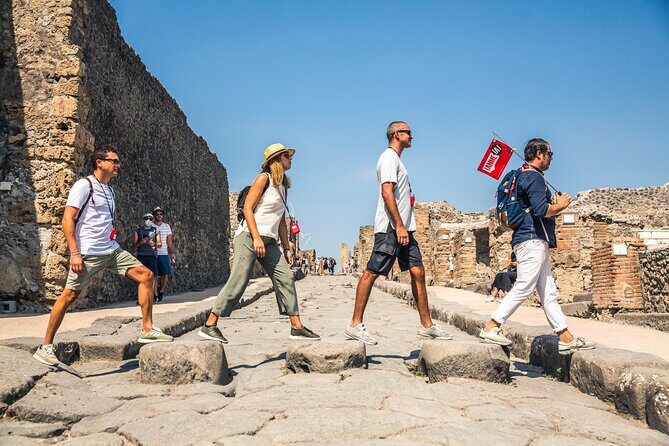
Also plan for terrain. Pompeii has steps, inclines, and uneven ancient stone. Some people find it challenging even when they’re generally mobile. Strollers are mentioned as allowed in contrast to wheelchairs, and there’s also a point to note: the tour isn’t marketed as wheelchair accessible. If that’s part of your needs, I’d treat this as a “check with care” situation and make sure you can handle rough ground.
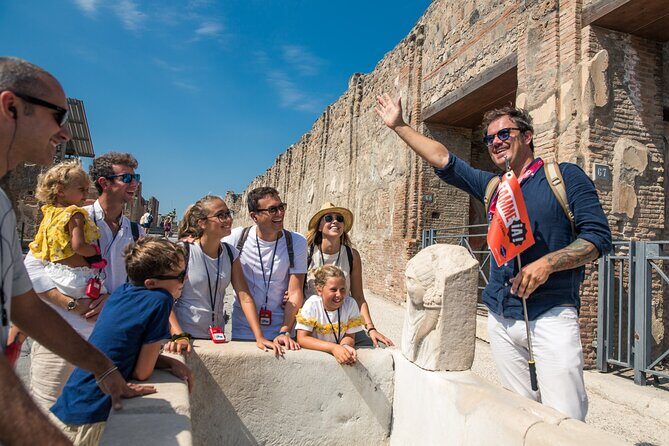
On the positive side, the guide usually keeps the group moving while still making room for questions. More than once, guides like LuLu, Lucio, Roberta, Isabella, or Patricia are praised for turning the walk into a story you can follow.
Who this Pompeii tour suits best (and who might want a different plan)
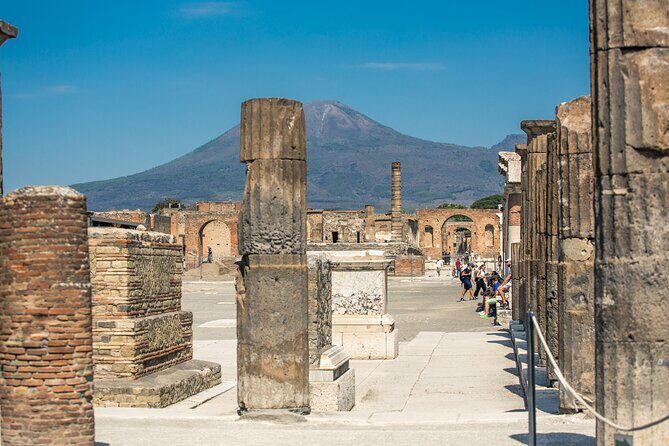
This is a great fit if you want structure. You’re in Sorrento, you have limited time, and you’d rather spend your energy on Pompeii’s meaning than figuring out routes across a huge archaeological park.
It’s also a strong choice for families who want a guided route. Some travelers have done this with kids and appreciated that the guide kept the narrative clear while still moving through multiple highlights.
Choose a different style of tour if you need long personal stop time. One concern that pops up is that you stay with the group most of the day, so there isn’t much free wandering to re-check a favorite spot or visit a shop/store on your own.
Price and value: what $90.70 buys you
At $90.70 per person, the value comes from what’s included. You’re paying for round-trip transportation, skip-the-line Pompeii admission, an official guide, and entry to the archaeological site. You also get headphones in Pompeii for groups over 10, which helps the experience stay intelligible even when you’re moving and stopping often.
The big “not included” item is simple: food and drinks. That means you should plan to buy a snack or bring water, especially if you’re going during warmer parts of the day. The tour seems designed to keep the walking and viewpoints efficient, so you’ll likely want your energy ready for the next section.
If you were to buy tickets and figure out the route alone, you’d still face the challenge of deciding what matters most. This tour saves you that decision fatigue and gets you into the story quickly.
Should you book this skip-the-line Pompeii tour from Sorrento?
Book it if you want Pompeii made practical: fast entry, an organized path through key areas, and a guide who helps you connect ruins to real daily life. It’s also a smart move when you’re short on time or you prefer not to think about tickets, timing, and navigation.
Skip it (or consider a different format) if your biggest priority is slow wandering and lots of solo time. Pompeii’s ground is uneven, and even with guide support, this is still a walking-heavy day. Also, if you need a more accessible plan, you’ll want to double-check what your specific mobility needs require before committing.
If your goal is to come away understanding how Pompeii worked—public square, market, baths, private houses, and theater—this one is a solid use of a day in Campania.
FAQ
Where do you meet in Sorrento?
You meet at IAMME IA! – Gray Line Amalfi Coast, Piazza Torquato Tasso, 16, 80067 Sorrento.
How long is the Pompeii portion of the tour?
The Pompeii time on site is about 2 hours, with additional shorter stops around other highlights as part of the full experience.
Is the skip-the-line ticket included?
Yes. You get skip-the-line admission access for the Pompeii Archaeological Site.
Does the price include admission?
Yes. Entry/Admission to the Pompeii Archaeological Site is included.
Do you get headphones during the tour?
Headphones are provided in Pompeii to hear the guide clearly for groups bigger than 10 passengers.
Is food and drinks included?
No. Food and drinks aren’t included.
Can I cancel for a full refund?
Yes, free cancellation is available up to 24 hours before the experience start time for a full refund.