REVIEW · POMPEII
Pompeii: Exclusive Private Walking Tour with an Archaeologist
Book on Viator →Operated by Hili Travel s.r.l. · Bookable on Viator
Pompeii feels personal on a private walk. This exclusive Pompeii archaeologist tour is a smart way to see major stops without wasting time figuring out what you’re looking at, all in about two hours. You’ll get an English-speaking local guide and a route that moves through homes, public life, and the city’s big landmarks.
I love starting at Casa del Menandro, because the minute you see how the rich lived, the rest of Pompeii stops feeling like random ruins. I also love the rhythm: short, well-chosen stretches at big hitters like the Teatro Grande and Via dell’Abbondanza, so you leave with clear takeaways instead of just photos.
One consideration: Pompeii entry tickets aren’t included, so you’ll need to purchase the archaeological site admission separately before (or around) your tour time.
In This Review
- Key reasons this Pompeii tour earns repeat bookings
- Getting to Pompeii fast (and meeting your guide without stress)
- What makes it feel truly private (up to 12, not a herd)
- Casa del Menandro: how one luxury house sets your whole mindset
- What to watch for during the stop
- Stabian Baths (Terme Stabiane): the oldest big public bath complex
- Why this stop is worth your time
- Lupanar: art, anatomy, and the uncomfortable side of Pompeii
- How to get the most out of it
- Casa del Fauno: the palace feel of a Hellenistic home
- What the guide should help you notice
- Teatro Grande, Via dell’Abbondanza, and Foro di Pompeya: the city’s stage, street, and heart
- Teatro Grande: Pompeii’s biggest theatre
- Via dell’Abbondanza: the best-preserved main street feel
- Foro di Pompeya: the most important square
- Why the order works
- Price and value: is $421 per group a good deal?
- Who should compare this to other options
- How to make the most of your 2 hours on the ground
- Guide quality is the difference between a good walk and a great one
- Should you book this Pompeii exclusive private walking tour?
- FAQ
- Is the Pompeii entry ticket included?
- How long is the tour?
- Is this a private tour?
- What language is the tour offered in?
- Where do we meet and where does it end?
- What if plans change and I need to cancel?
Key reasons this Pompeii tour earns repeat bookings
- Private group only for your people: up to 12, so the guide can adjust pace and questions.
- Archaeologist-led explanations: you’re not just reading signs; you’re getting the story behind what you see.
- A high-impact 2-hour route: houses + baths + civic spaces, so you get the full city feel fast.
- Start point you can locate: Coffee Shop Vittoria Via Mare is your anchor for meeting.
- Guides with personality: names like Clelia, Leonardo, Ines, Paolo, and Lello come up for humor and clarity.
Getting to Pompeii fast (and meeting your guide without stress)
This tour is built for a limited time window: about 2 hours, with the walking kept tight and purposeful. You start back where you meet—at Coffee Shop Vittoria, Via Mare, 80045 Pompei NA, Italy—so you don’t end up stranded on the far side of the site.
You’ll also use a mobile ticket, which is handy on a day where you’re juggling shoes, water, and the usual Pompeii crowd chaos. The big practical note is that you’ll need to arrange separate entry tickets to the archaeological area. If you skip that step, you’ll slow the group down right when you want to be moving.
If you’re the kind of person who likes to avoid any start-of-day surprises, do this: check the exact company name and guide instructions in your confirmation message before you head out. One past booking flagged confusion at the meeting moment, so having your details ready helps you avoid a messy scramble.
If you're still narrowing it down, here are other tours in Pompeii we've reviewed.



What makes it feel truly private (up to 12, not a herd)
Even though Pompeii can look like a crowded maze, this is not a free-for-all. It’s exclusive private, meaning only your group participates, with a local guide leading you through the site.
In practice, that’s where the real value shows up. You can ask follow-up questions when something catches your eye—an unusual pattern in a wall painting, the reason a space is shaped a certain way, why one part of the city feels more formal than another. It’s a big difference from tours that shout over the crowd.
The guide experience can matter a lot, and the names you might encounter—Clelia, Leonardo, Ines, Paolo, and Lello—tend to be known for storytelling plus good timing. Several descriptions mention humor as part of the teaching style, which helps when you’re standing still in the hot sun and trying to picture everyday life from fragments.
Casa del Menandro: how one luxury house sets your whole mindset
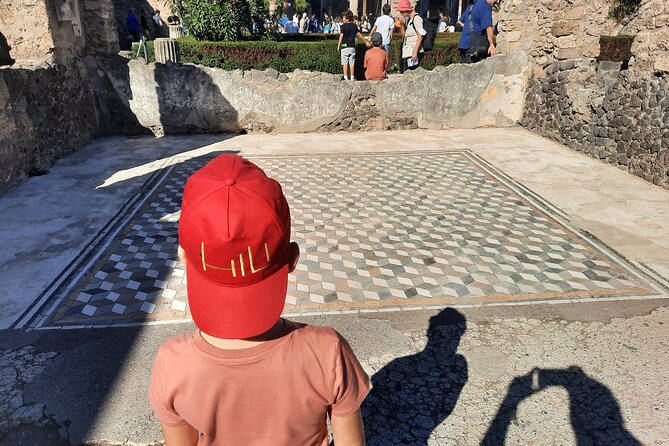
You kick things off at Casa del Menandro (House of Menander), one of Pompeii’s richest homes. The standout detail here is scale: it covers about 1,800 square metres and takes up most of its insula (city block). When you start at a place this elaborate, you learn what “wealth” actually looked like in Pompeii—architecture, decoration, and the objects people filled their rooms with.
This first stop is also a shortcut for your brain. After you see the layout of a top-tier home—where private spaces differ from the more public ones—you’ll recognize patterns as you move through the ruins. You stop thinking only about individual walls and start thinking about how people moved, met, worked, and displayed status.
What to watch for during the stop
Look at the sense of design: how rooms connect, how space feels planned rather than accidental, and how decoration signals importance. If you’re traveling with teens or first-timers, this is the stop that tends to turn “I see old rocks” into “I get how life worked.”
Stabian Baths (Terme Stabiane): the oldest big public bath complex
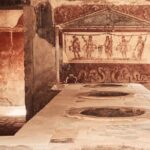
Next up: Terme Stabiane, the Stabian Baths. This is the kind of Pompeii stop that makes the city feel human. These baths were among the most central public places in town, and the Stabian complex is especially notable for age and size.
The original construction dates to around 125 BC, making it one of the oldest bathing complexes known from the ancient world. It’s also described as the oldest and largest of Pompeii’s five public baths. So while many ruins are “pretty to look at,” this one gives you a clear window into daily routines: washing, socializing, and community life.


Why this stop is worth your time
Baths are one of the fastest ways to understand a Roman city. You get a sense of civic priorities—public infrastructure, shared spaces, and routine. Even with a short visit, the layout helps you imagine the flow of people through bathing areas rather than treating the ruins as scattered chambers.
Lupanar: art, anatomy, and the uncomfortable side of Pompeii
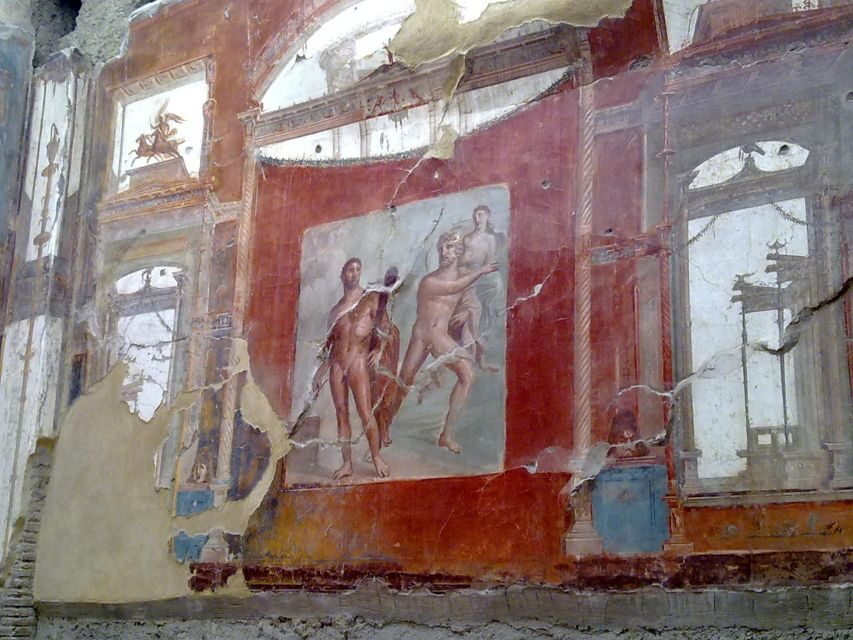
Then you’ll reach the Lupanar, a brothel in Pompeii, known especially for its erotic paintings on the walls. This isn’t a “light” stop, and it’s not meant to be. It’s part of Pompeii’s real record of human behavior: private commerce, social attitudes, and how the city tolerated and displayed the adult world.
If you’re bringing kids, or if explicit art would make your group uncomfortable, it’s worth deciding in advance whether this stop is a good fit. The tour is described as offering this stop regardless, so your best move is planning your comfort level before you’re standing in front of those walls.
How to get the most out of it
Treat it as context, not shock. Ask your guide what the paintings were doing—how they helped advertise services, how imagery functioned in street-level life, and what that reveals about Pompeii as a full society.
Casa del Fauno: the palace feel of a Hellenistic home
After the Lupanar, you head to Casa del Fauno, or Casa del Fauno (House of the Faun). This is a grand Hellenistic palace framed by a peristyle (a columned walkway around an inner space), and it was built in the 2nd century BC during the Samnite period (around 180 BC).
The “palace” label here matters. Starting to see peristyles and formal arrangements is what turns Pompeii from “one place” into “a set of different lifestyles.” Casa del Fauno gives you the sense that Pompeii wasn’t only about markets and streets—it could also be about grand, cultured domestic spaces with a clear architectural statement.
What the guide should help you notice
You’ll get more from this stop if you focus on how the peristyle works as a center of gravity. It’s the sort of feature that shapes movement and mood, and it helps you understand why Pompeii houses aren’t just rooms—they’re designed experiences.
Teatro Grande, Via dell’Abbondanza, and Foro di Pompeya: the city’s stage, street, and heart
The last stretch is where Pompeii starts to feel like a living map again.
Teatro Grande: Pompeii’s biggest theatre
You’ll see Teatro Grande, the biggest theatre in Pompeii. A major theatre is a strong clue about what a city values: public entertainment, civic identity, and gatherings that bring people together. Even if you only get a short stop here, it’s a key anchor for understanding public life.
Via dell’Abbondanza: the best-preserved main street feel
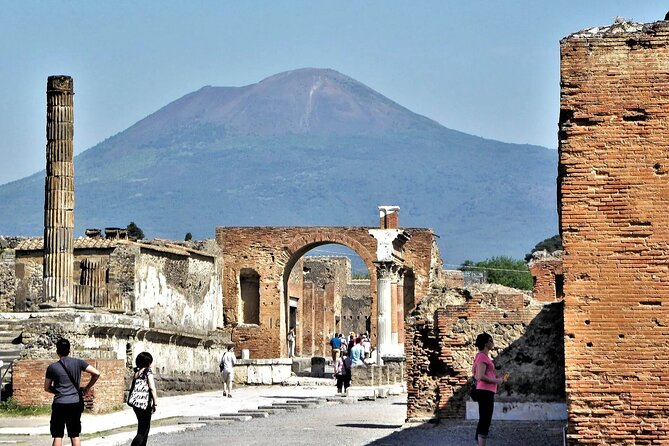
Then comes Via dell’Abbondanza, described as the best preserved street in Pompeii. Streets are where you learn scale. Houses look impressive, but streets are where you picture movement: where vendors might have set up, where people walked, and how everyday routines stitched the city together.
This is a stop that helps your photos make sense. If you’ve ever looked at Pompeii pictures and felt like you couldn’t tell where things were, seeing a well-preserved main street can help you build a mental model fast.
Foro di Pompeya: the most important square
Finally: Foro de Pompeya, the city’s most important square. This is the civic core—where power and community life met. When you end here, the city reads as a whole: entertainment (the theatre), daily motion (the street), and civic identity (the forum).
Why the order works
Starting with houses, moving into baths and the adult underbelly, then finishing with theatre-street-forum gives you a balanced picture. You don’t just get landmarks. You get how the pieces relate.
Price and value: is $421 per group a good deal?
At $421.03 per group (up to 12), this is priced for groups who want a guided path through a huge site in limited time. On paper it can look high if you’re comparing per-person costs of generic audio tours. But this isn’t an audio loop. It’s a private archaeologist-led walk with an English-speaking local guide.
The value shows up in two ways:
- Time savings in Pompeii: Pompeii is enormous. Two hours with a focused route beats wandering with no context.
- You get explanations at every stop: the tour isn’t only about getting from point A to point B. It’s about understanding what you’re looking at while you’re still standing there.
Demand also hints at value: this tour is often booked about 57 days in advance. If you’re traveling in peak season, plan early so you’re not stuck with a less suitable time.
Who should compare this to other options
If you want a full-day, slow, see-everything schedule, you might still pair Pompeii with self-guided time afterward. But if you want the highlights with clear guidance in about two hours, the price becomes easier to justify.
How to make the most of your 2 hours on the ground
Pompeii tours succeed or fail based on how you prep. Here are the habits that work with this style of route:
- Buy your entry ticket separately in advance so your group doesn’t wait at the gate.
- Wear real walking shoes and plan for uneven stone. Even “short” stops add up.
- Bring water. A guided run through houses and baths takes energy, even at a comfortable pace.
- Use your guide’s brain: ask one question per stop. You’ll remember more, and the guide can steer you to details you might miss.
Also, if your group includes people with different interests—architecture lovers, teens who want the biggest sights, and anyone who prefers fewer “adult” topics—tell your guide preferences early. Private tours are flexible in a way bigger groups usually can’t be.
Guide quality is the difference between a good walk and a great one
This kind of tour lives and dies by the guide. The names that come up—Clelia, Leonardo, Ines, Paolo, Lello/Lilo—tend to be described as engaging, with humor and clear explanations that help you picture Pompeii as it was, not just as it is now.
A couple notes to keep you grounded:
- One experience flagged the guide meeting as difficult due to confusion about the company name and where the guide met the group. So verify your message details.
- One booking mentioned a stricter tone from a guide. That may matter if you want lots of banter, but the upside is that you still get the archaeological story and structure-focused walk.
If you care about atmosphere, send a note or check the guide assignment when available. Otherwise, assume Pompeii plus an archaeologist guide will do most of the work.
Should you book this Pompeii exclusive private walking tour?
If you’re visiting Pompeii for the first time and you want a guided, high-impact route that covers houses, public baths, a standout adult site, and the city’s big civic spaces, this is a strong fit. It’s also a good choice if you have limited time and you want to leave with context, not just impressions.
Book it if you:
- want an archaeologist-led explanation in English
- prefer a private group setup (up to 12)
- like the idea of a structured route in about two hours
- are comfortable purchasing the Pompeii entry ticket separately
Skip it (or choose another format) if you:
- want to spend most of the day exploring at your own pace without stops
- dislike explicit erotic imagery shown at the Lupanar
FAQ
Is the Pompeii entry ticket included?
No. The tour includes the guided experience, but you need a separate entry ticket to the archaeological area.
How long is the tour?
It runs for about 2 hours.
Is this a private tour?
Yes. It’s private and only your group participates, with capacity up to 12 people.
What language is the tour offered in?
The tour is offered in English.
Where do we meet and where does it end?
You meet at Coffee Shop Vittoria, Via Mare, 80045 Pompei NA, Italy, and the tour ends back at the same meeting point.
What if plans change and I need to cancel?
You can cancel for a full refund if you cancel at least 24 hours before the start time. If you cancel less than 24 hours before, the amount paid is not refunded.