REVIEW · POMPEII
Pompeii Walking Tour: The Real History of the Ruins
Book on Viator →Operated by InStazione · Bookable on Viator
Pompeii feels like a city frozen. This 2-hour guided walk takes you through the layers of Roman daily life still visible after the eruption buried the town in AD 79. You’ll move from big public spaces to quieter domestic corners, with a guide turning stone, stucco, and street plans into something you can understand fast.
I love how much you pack in for a $42.05 price: major sights plus the admission ticket, all handled by one guide. And I especially like the way the tour connects buildings to how people actually lived, from theater performances to public baths to the forum’s legal and trading space.
The main drawback to plan for is timing and pacing. This tour is about 2 hours, so you’ll get short visits at each stop, and there can be schedule friction if your morning transport timing is tight.
In This Review
- Key things I’d bookmark before you go
- Pompeii in Two Hours: what this walking tour gives you
- InStazione meet-up and getting to Porta Anfiteatro on time
- Teatro Grande: Roman theater you can still picture
- Casa del Menandro: a wealthy domus with a name that sticks
- Stabian Baths: the oldest bath complex you’ll see on the route
- Lupanar and the forum streets: seeing life where it happened
- Temple of Jupiter and the Basilica: law, power, and judgment in stone
- Temple of Apollo and the granaries: religion plus trade math
- What the guide adds (and how to match the tour to your style)
- Should you book this Pompeii walking tour?
- FAQ
- How long is the tour?
- What time does it depart each day?
- Is the tour offered in English?
- What’s included in the price?
- Is lunch included?
- How large is the group?
- Does the tour require good weather?
- Can I cancel for a full refund?
Key things I’d bookmark before you go
- Small-route focus: You hit the highest-impact ruins without spending the whole day hopping around.
- Admission included: Entrance tickets and the guided walkthrough are part of the price.
- Roman life in layers: Theater, homes, baths, a lupanar, and forum buildings all in one arc.
- A guide changes everything: Expect explanations that make the ruins more legible, not just photographed.
- Pace is fast: Short stop times mean you’ll want to move with the group.
Pompeii in Two Hours: what this walking tour gives you
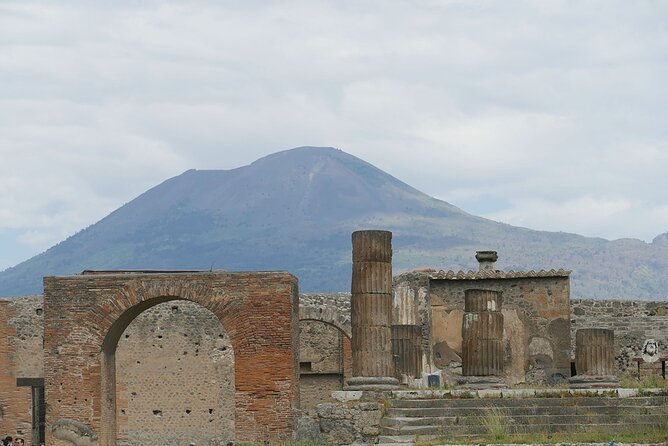
Pompeii is the kind of place that can overwhelm you if you show up cold. You see walls and doorways and street grooves, but the meaning can take a while to land. This tour is built to solve that problem by keeping you in motion and giving you a clear storyline about Roman life.
For the money, you’re paying for interpretation plus logistics. At $42.05 per person, you get a guided walk and the entrance ticket included, which matters in Pompeii because you’ll otherwise spend time figuring out access and then still need someone to explain what you’re looking at.
The tour runs about 2 hours and caps the group at 35 people. That size is large enough to keep it affordable but small enough that you should usually be able to hear the guide and see what’s in front of you. It’s offered in English, and the experience is designed so most people can manage the walking pace.
If you're still narrowing it down, here are other tours in Pompeii we've reviewed.


InStazione meet-up and getting to Porta Anfiteatro on time
The tour departs daily at 10:30 am from the InStazione help desk. After you register your details, you walk through together with the guide to the entrance at Porta Anfiteatro. For first-timers, this is a big help because Pompeii’s entrance points can feel confusing if you’re arriving on your own.
My practical tip: give yourself a buffer before 10:30. There are hints that start times and pickup information can be messy on some mornings, including cases where the tour start didn’t match what people expected. If your train or connection is even slightly off, arriving early is how you keep stress from eating your tour time.
Also, remember this is not a museum crawl. It’s a guided walk with multiple stops, and the group has to keep moving. If you like asking lots of questions, it helps to do it when the guide pauses at a major site rather than trying to catch up at the fastest street segments.
Teatro Grande: Roman theater you can still picture
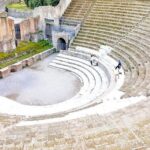
You start with the Teatro Grande, a Roman theater buried by Vesuvius in 79 and uncovered during Pompeii excavations. This isn’t just a shell you look at from the outside. The guide helps you understand what performances happened here and why the theater matters for how the Romans spent leisure time.
Inside, performances included comedies, mimes, pantomimes, and atellane. Those names sound technical, but the payoff is simple: you get a better sense that theater wasn’t a niche hobby. It was a public rhythm, with stories and performance styles that could reach broad audiences.
Look for how the space is shaped for sightlines and for crowd movement. When you hear what kinds of shows took place there, the stone layout starts to make sense, like your brain is rebuilding the scene on top of the ruin. The time here is short, but it sets the tone for the rest of the walk: Pompeii isn’t only houses and streets; it’s also entertainment infrastructure.
Casa del Menandro: a wealthy domus with a name that sticks
Next comes the Casa del Menandro, a large urban domus of about 1,800 m². It was excavated between 1926 and 1932, and it’s a strong example of a well-off Roman household rather than a modest one-room dwelling.
This house earns its name from an image of the Greek poet Menander found there, not from a specific owner you’d find on a deed. That detail matters because it hints at how education, art, and cultural references worked their way into everyday domestic space. You’re not just seeing wealth; you’re seeing taste and intellectual branding.
In a short stop like this, I focus on three things: the scale of the rooms, the way decor is distributed, and how the house fits into the street world outside. The house is the kind of place where, even with limited time, you begin to understand how privacy and public-facing life could exist side by side in Pompeii.
Stabian Baths: the oldest bath complex you’ll see on the route
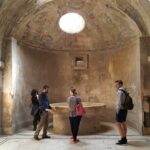
The Stabian Baths (Terme Stabiane) are next, and they’re a big deal for one reason: they’re described as the oldest bath building in Pompeii. Like the rest of the ruins, they survived under volcanic ash, so the structure gives you a rare look at Roman bathing life.
One detail you won’t want to miss is that the male and female sectors are described as perfectly preserved. That’s not just an architectural note. It helps you picture how Roman society organized routine, space, and privacy within a shared public activity.
Baths weren’t only about cleanliness. They were social, political, and time-filled spaces. When the guide connects the rooms to that daily routine, you start seeing the baths as a schedule, not just a pile of stone basins and corridors.
Time here is around 15 minutes, so don’t try to photograph everything at once. Instead, pick a couple of areas the guide points out and let those be your anchors for what the bath complex is doing.


Lupanar and the forum streets: seeing life where it happened
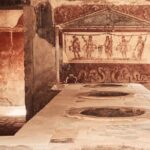
After the baths, you’ll step into the lupanar, the site associated with mercenary sexual pleasure in the Roman era. The tour frames it as a real place of “houses of tolerance,” and some of the structure is still visible. This is the stop that makes Pompeii feel most human, because it’s not clean or heroic. It’s daily life, including the parts people don’t like to discuss back home.
If you’re uneasy about explicit subject matter, this is the moment to decide how you want to handle it. You can still appreciate the historical evidence, but you don’t have to stand and stare past your comfort level. A good guide keeps it factual and contextual, and you should be able to move at your own pace within the group flow.
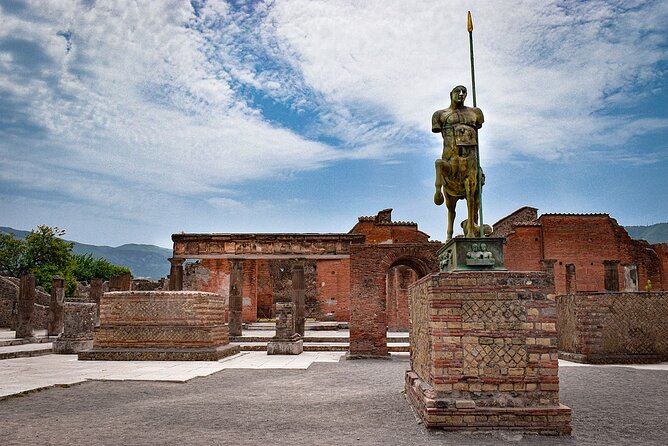
From there, you go into the Forum of Pompeii, an area built around the 4th century BC in the Samnite era near key roads. After Roman conquest, the forum was rebuilt and enlarged, especially in the 2nd century BC, which is why you see evidence of changing political and religious priorities over time.
The forum works well on a walking tour because it’s both architecture and geography. You’re looking at the open square where shops and civic activity would have happened, surrounded by key religious and legal spaces. The time here is short, but you’ll get a sense of the forum as a traffic hub: roads leading out, businesses fronting the square, and the power structures nearby.
Temple of Jupiter and the Basilica: law, power, and judgment in stone
In the forum area, you’ll see the Temple of Jupiter, later associated with the Capitolium idea and dedicated to the three main divinities of Rome: Jupiter, Juno, and Minerva. The guide also explains that the temple’s basement held sacred furnishings and the public treasure called erarium.
That’s one of those details that changes how you view a temple. It’s not only ritual space. It’s also a storage point for public wealth, which means religious authority and civic power were tightly connected.
Next is the Basilica, a major public building dating to the 2nd century BC. It functioned like an indoor version of the forum when weather pushed people inside. Inside, you’ll see the tribunal area where the judge sat elevated above the parties, with access described as protected by a mobile wooden staircase so the condemned couldn’t attack the judge.
This is the kind of small structural detail that makes the whole political system feel real. You can almost hear the practical reasoning: control the movement, control the risk, and keep the court order visible.
Time at the Basilica is about 5 minutes, so treat it as an overview. If you want deeper analysis, plan to return later with a longer visit or a second walk focused on civic buildings only.
Temple of Apollo and the granaries: religion plus trade math
Toward the end, you’ll visit the Temple of Apollo. The tour ties Apollo’s cult to Italic populations passing through the Greek world. Near the time of the eruption in 79 AD, Apollo’s following is described as having lost ground as Jupiter’s importance grew.
Inside what remains, you can see a bronze statue described as an archer, plus an observation point for a goddess statue connected to Diana. Even with brief timing, the guide’s explanation helps you understand the political-religious competition happening in Pompeii’s religious landscape.
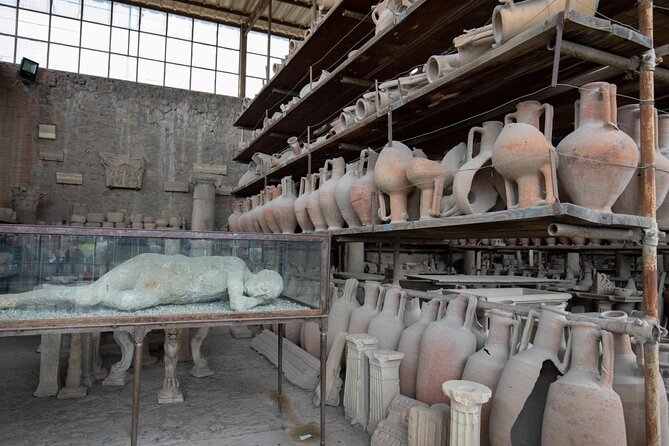
Finally, you reach the granaries area. Today it’s described as a deposit of excavation materials, but in the past it was a market space for cereals and legumes. One clue is that no plaster traces were found there, which led to the idea that the structure wasn’t finished when the eruption happened.
The granaries also connect to trading rules through a ponderary table, where tools were kept to guarantee exchange correctness and to convert measurement units traders used across different parts of the empire into Pompeii’s local units. That’s a surprisingly satisfying ending, because it turns Pompeii from an art-and-architecture destination into a place with real commerce and real paperwork.
What the guide adds (and how to match the tour to your style)
A guided Pompeii walk is only as good as the guide’s ability to explain what you’re seeing. In this type of tour format, the strongest guides bring humor and pace control, and they make the city feel like a lived place instead of a diagram. Names you may see in past groups include Grace, Frederica, Vincenzo, and Igor, all described as engaging and able to explain in clear, relatable ways.
So what should you do as a reader? If you want lively storytelling, look for cues like guides who can handle both the big picture and the small details without losing the group. If you’re very sensitive to heavy politics or prefer quieter pacing, consider that not every guide will emphasize the same themes.
Also, keep your expectations realistic: you’re not doing Pompeii cover-to-cover. You’re doing a high-value selection in about 2 hours, and that means you’ll get clarity on the places the guide prioritizes.
Should you book this Pompeii walking tour?
Book it if this is your first time in Pompeii and you want clear explanations fast. The mix of Teatro Grande, Casa del Menandro, Stabian Baths, the lupanar, and the forum’s civic buildings is a smart way to understand Roman life without spending your whole day planning entry routes and then still struggling to interpret ruins.
Skip it or look at another option if you want long independent time at each site. The stops are brief, and you’ll move on even if you want more lingering. Also consider that one stop involves sexual-history subject matter, so go in knowing that’s part of Pompeii’s evidence.
If you’re the kind of traveler who loves being shown what to notice, this one is a solid value: admission included, a tight route, and a guide timed to help you make sense of a place that otherwise can feel like random stones.
FAQ
How long is the tour?
The Pompeii walking tour runs for about 2 hours.
What time does it depart each day?
It departs daily at 10:30 am.
Is the tour offered in English?
Yes, it is offered in English.
What’s included in the price?
The entrance ticket and the guided tour are included.
Is lunch included?
No, lunch is not included.
How large is the group?
The tour has a maximum of 35 people.
Does the tour require good weather?
Yes. The experience requires good weather, and if it’s canceled due to poor weather you’ll be offered a different date or a full refund.
Can I cancel for a full refund?
Yes. You can cancel up to 24 hours in advance for a full refund.