REVIEW · POMPEI CAMPANIA
Pompei: Audio guide of the archeological site
Book on GetYourGuide →Operated by Echo Audioguides · Bookable on GetYourGuide
Pompeii is big, and your time is short. This audio guide turns the ruins into a guided walk you can control, with compelling narration that explains what you’re seeing as you move. It’s also budget-friendly, which matters here because Pompeii can eat your wallet fast once you add extras.
What I like most is the clear historical storytelling and the fact that it gives you a map to follow a path instead of guessing where to go next. The narration is the main draw: it brings everyday life and Pompeii’s tragic end into focus without making you feel rushed.
One thing to watch: it doesn’t include your entrance ticket or earphones. If you arrive without those, you’ll lose time. Also, at least one low rating was vague about being misguided, so read what’s included before you assume it’s a full tour with admission.
In This Review
- Key things to know before you go
- What You Get From Echo Audioguides in Pompeii
- The Pompeii Audio Walk: 50 Minutes, Then You’re Free
- Following the Map: How to Avoid the Most Common Pompeii Problem
- Markets, Villas, and Temples: The City Explained in Human Scale
- Bathhouses and Frescoes: When Pompeii Feels Personal
- Offline Access and Two-Day Validity: Practical for Real Visits
- Price and Value: Is $5 a Good Deal Here?
- The One Drawback to Take Seriously
- Who Should Book This Pompeii Audio Guide?
- Practical Tips That Make It Work on the Ground
- Should You Book This Pompeii Audio Guide?
- FAQ
- How long is the Pompeii audio guide?
- Is the audio available offline?
- What languages are offered?
- What’s included in the price?
- Do I need to buy my own entrance ticket?
- Is a refund available if my plans change?
Key things to know before you go

- A 50-minute Pompeii walkthrough that fits into a focused visit
- Offline-ready audio via a link with unlimited access
- A map included, so you can navigate instead of wandering randomly
- Narration covers daily life, from markets and villas to temples and bathhouses
- Frescoes and household details help you connect ruins to real people
- Budget pricing ($5) makes it a smart add-on if you’re already visiting Pompeii
What You Get From Echo Audioguides in Pompeii

This experience is run by Echo Audioguides and sold as a digital add-on for people who already plan to visit Pompeii on their own schedule. For $5 per person, you’re not paying for a group meeting or a staff-led tour. You’re paying for structure: a guided audio track, plus tools to help you follow it.
Included in the package:
- a map
- a digital file (delivered by link)
- photo materials
- documentation
What’s not included is the stuff that often causes disappointment if you forget it:
- entrance ticket to the archaeological site
- earphones
Languages are Italian and English, and there’s an Italian/English host/greeter listed. In practice, this matters because you can match the narration to your comfort level rather than being stuck listening in a language you don’t fully follow.
If you’re the type who likes to see the main sights but hates the rigid pace of guided groups, this format makes sense. You get a “plan” without losing control of your feet.
Other Pompeii entry tickets and audio guides



The Pompeii Audio Walk: 50 Minutes, Then You’re Free

The core of this guide is a 50-minute audio experience through Pompeii’s streets and spaces. That time window is useful. Pompeii can be overwhelming because it’s vast and full of textures—walls, doorways, steps, courtyards—so having a timed storyline helps you anchor what you’re looking at.
The guide is described as in-depth and expertly narrated, with clear navigation cues and historical context. The big win here is that it doesn’t treat Pompeii like a museum slideshow. It frames the ruins as a functioning city: markets where people shopped, villas where wealth and daily routine lived side by side, and temples where religion shaped public life.
You should also appreciate the flexibility angle. Once you have the audio file link, you’re not locked into one departure time like you would be with a live guide. That’s good if you’re touring other parts of Campania (or if you want to arrive early to dodge crowds and heat).
Following the Map: How to Avoid the Most Common Pompeii Problem

Pompeii is famous, but that doesn’t make it easy. Without help, it’s simple to spend time circling the same areas or heading to a spot that doesn’t match the story you meant to hear.
This guide includes a map, and a big chunk of the positive feedback points to that practical value—people specifically called out that the map helps you follow the path. That’s exactly what you want for an audio experience. Audio works best when your eyes can quickly confirm where you are, so the narration feels like it’s steering you rather than just talking at you.
Here’s how you can use the map for best results:
- Plan to sync it early, before you settle into a slower pace.
- When you hear a new topic start (like markets, villas, or temples), glance at the map and match it to the direction you’re already walking.
- Don’t force a straight-line route. Pompeii rewards short stops—just keep checking that you’re still aligned with the audio.
Also: because this is not an admission ticket, you’ll want to get inside first, then start listening. Jumping in with a fully focused “audio mission” right away helps you get more meaning out of every doorway and wall you pass.
Markets, Villas, and Temples: The City Explained in Human Scale
The guide’s content focuses on places that feel everyday, even though you’re standing in ancient ruins. That’s a key difference between an audio track that just lists facts and one that explains life.
You can expect sections that bring:
- markets back to life as social and economic centers
- villas with a sense of space, privacy, and status
- temples that reflect how public and private belief shaped routines
What I like about this choice of topics is that it prevents the “tourist tunnel vision” problem. If you only chase the biggest, most famous structures, Pompeii can feel like a pile of impressive stone. But when the audio keeps tying architecture to daily decisions—where people gathered, how homes were organized, how public spaces worked—you start noticing details that would otherwise look like generic ruins.
A good example of what to do while listening: when the narration moves into homes or community spaces, look for thresholds and layout cues. Doorways, courtyards, and openings aren’t just decoration. They show how people moved through their days.
Bathhouses and Frescoes: When Pompeii Feels Personal
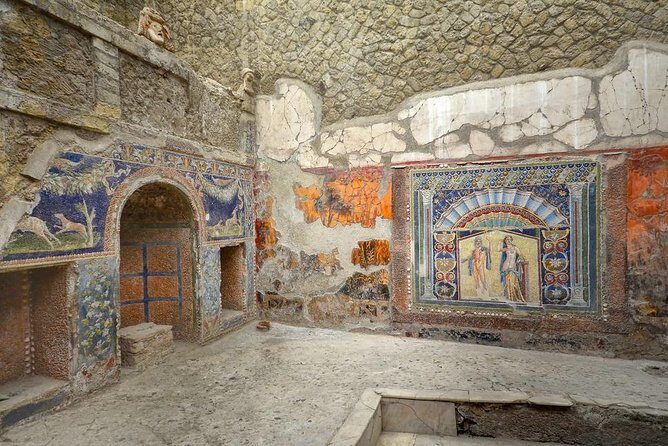
Pompeii’s most emotional value often shows up in the small things—paint, private spaces, and how ordinary life was arranged. This audio guide is described as covering grand bathhouses and intimate household frescoes, which is a smart mix.
Bathhouses:
- If the audio mentions them, use that time to focus on scale and repetition—places built for movement and routine.
- These spaces help you understand that Pompeii wasn’t only tragedy and rubble. It had comfort, public habits, and a daily rhythm.
Household frescoes:
- When the guide brings up frescoes, slow down visually. Look at how imagery sits on walls and what remains visible.
- Fresco mentions are a hint to pay attention to “taste” and daily aesthetics. Even when the story is tragic, the art reminds you people had preferences.
This is where you’ll likely get the most payoff from an audio guide: it turns what could be quick sightseeing into a mental picture of how people lived. And with Pompeii, that’s the difference between seeing ruins and understanding them.
Other guided tours in Pompei Campania





Offline Access and Two-Day Validity: Practical for Real Visits
You’ll receive a link to the audio file, with unlimited access, and it’s designed to work even offline. That detail sounds small until you hit a practical problem—spotty reception, low battery, or a moment where you want to keep walking without searching for Wi‑Fi.
Also note the timing terms:
- The audio experience is about 50 minutes
- Access is valid for 2 days, with availability showing starting times
So think of this as “one planned listen,” but with room for replays or catch-up. If you want to pause, step away, then restart later, you can. That flexibility is especially useful if you split your Pompeii time across a morning and afternoon.
If you like to relive the walk afterward, offline access supports that too—no scrambling for internet, no hunting for the file.
Price and Value: Is $5 a Good Deal Here?
At $5 per person, this guide is priced like an add-on, not a premium guided experience. That’s exactly how it should be judged.
You get:
- narration with historical authenticity
- a map
- the ability to download and listen offline
- English and Italian options
- photo and documentation support
You don’t get:
- entry into Pompeii
- earphones
So the value depends on how you tour. If you already plan to enter Pompeii, $5 is a low-cost way to add structure and context. If you were hoping for a full live guide plus admission, you’ll feel the gap fast—because this is an audio companion, not a guided ticket package.
Given the mix of feedback and the overall rating of 3.4 (13 reviews), I’d call this a reasonable buy if you read the inclusions carefully and show up prepared (ticket + headphones). The best part is the “you control the pace” benefit. For many visitors, that’s worth more than paying extra for someone to herd you through.
The One Drawback to Take Seriously
A single low rating says Misguided really, but it doesn’t explain the reason. When feedback is that short, the safest takeaway is simple: confirm what this is before you rely on it.
From the provided details, the most likely friction points are:
- You still need your entrance ticket
- You still need your own earphones
- It’s an audio guide, so the experience won’t be live commentary or Q&A
If you can accept those boundaries, the rest fits well with what the guide promises: clear navigation, historical storytelling, and a self-paced way to learn.
Who Should Book This Pompeii Audio Guide?
I’d point this toward travelers who want independence but still crave context. It’s a strong match for:
- history buffs who don’t want a scripted group pace
- curious travelers who like to understand what they’re looking at as they go
- budget-minded visitors who already have Pompeii entry covered
- people who enjoy repeating stories by re-listening offline later
It may not be ideal if you:
- need a fully planned, staff-led route with guaranteed “cover everything” guidance
- show up without buying earphones or arranging your entry ticket
- expect a longer, day-spanning guided experience (this is centered on a ~50-minute audio track)
Practical Tips That Make It Work on the Ground
A few small moves can dramatically improve how useful the audio feels:
- Bring earphones. They’re not included, and you’ll want to listen right when you’re at the right spot.
- Save battery before you enter. Offline audio is great, but low phone power can still wreck your plan.
- Start the audio after you’re inside. You’ll waste less time matching narration to real space.
- Use the map to confirm direction whenever the topic changes (markets to villas to temples).
- If you’re short on time, don’t try to hear everything perfectly. Use the narration as a “guide script” and keep walking.
And yes—Pompeii can make you want to stop every five minutes. That’s not a problem. Just make sure your audio and your eyes stay synced, so the ruins feel connected instead of random.
Should You Book This Pompeii Audio Guide?
If you’re visiting Pompeii already and you want a low-cost, offline-ready way to understand what you’re seeing, this is an easy yes. The map, the 50-minute guided narration, and the coverage of markets, villas, temples, bathhouses, and household frescoes are a strong bundle for the price.
I’d skip or rethink it only if you’re hoping for admission and earphones included, or if you want a live, interactive guide style. This product shines for travelers who like to walk at their own pace—but still want the city explained in clear, historical terms.
In short: for $5, it’s one of the smartest ways to turn Pompeii from ruins you recognize into places you understand.
FAQ
How long is the Pompeii audio guide?
The audio guide is designed for about 50 minutes of listening.
Is the audio available offline?
Yes. You receive a link to the audio file for unlimited access, and it works even offline.
What languages are offered?
The audio guide and host/greeter are available in Italian and English.
What’s included in the price?
Included items are a map, digital file, photo, and documentation.
Do I need to buy my own entrance ticket?
Yes. Entrance ticket to the archaeological site is not included.
Is a refund available if my plans change?
Yes. Free cancellation is available up to 24 hours in advance for a full refund.